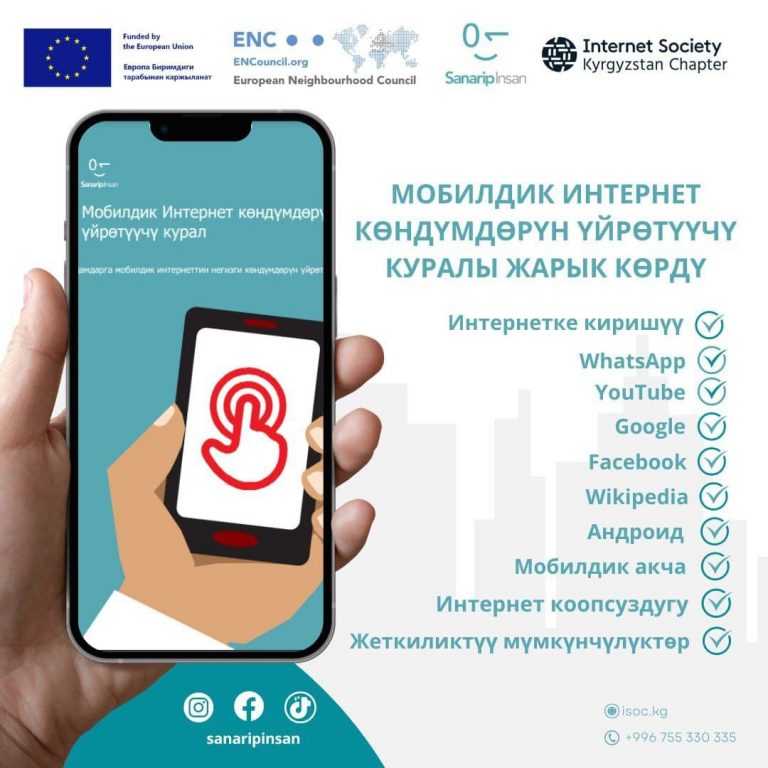
Mobile Internet Skills Training Toolkit released in Kyrgyz and Russian languages

The Sanarip Insan project aimed to address the critical issue of low digital literacy rates, particularly among rural youth and women in the Kyrgyz Republic. Despite the high mobile phone penetration rate in the country, many individuals lacked the skills to effectively use mobile devices beyond basic communication. Recognizing the significance of a mobile-first approach, Sanarip Insan partnered with international platforms to adapt their expertise to local needs and realities.

To promote digital inclusion and economic development in the region, the project successfully localized the GSMA Foundation’s Mobile Internet Skills Toolkit (MIST) into Kyrgyz and Russian languages. Training sessions based on the MISST Framework were conducted in all regions of the country. This approach proved instrumental in advancing mobile literacy skills among rural populations with limited access to fixed broadband infrastructure and desktop computers.

As of the beginning of 2023, the total population of Kyrgyzstan was 7.37 million, with 62.3 percent residing in rural areas. Given the high mobile phone penetration rates and the increasing usage of mobile internet in the country, it is crucial for development organizations to adopt a mobile-first approach in their interventions.

In its efforts to promote digital literacy skills among rural youth and women, Sanarip Insan organized offline training sessions for over 250 participants. These training served as valuable opportunities to test the mobile literacy toolkit in real-world settings. Through these sessions, participants were able to enhance their digital literacy skills, gain a better understanding of mobile platforms and applications, and acquire hands-on experience in using mobile devices.

In addition to the training, Sanarip Insan collaborated with the Presidential Administration and the Ministry of Youth, Culture, and Information to broadcast bite-sized videos about digital platforms and basic digital literacy skills on national and regional TV channels. These videos were produced in both Kyrgyz and Russian languages to maximize their reach. Through this partnership, Sanarip Insan successfully reached 4 million people, accounting for 55% of the country’s total population, particularly those residing in rural areas.

By combining offline training and national TV channels, Sanarip Insan made a significant impact on improving digital literacy skills among rural populations in the Kyrgyz Republic. This approach not only promoted digital inclusion but also empowered individuals to participate in the global digital economy. Through these efforts, Sanarip Insan demonstrated how targeted interventions, developed in collaboration with international partners and adapted to local contexts, can effectively promote sustainable development and contribute to the achievement of the Sustainable Development Goals.

Startup competition from the Sanarip Insan project

On July 26 of the current year, the “Sanarip Insan” project announced a startup competition.

Startups were announced in the following directions:

  • IT solutions: development of social and tourism services based on digital platforms.
  • Education sector: preparation for advancing education levels and developing digital skills.
  • E-commerce: increasing sales, optimizing marketing, enhancing customer service, e-business projects in the electronic commerce field.
  • Artificial Intelligence: business projects based on artificial intelligence platforms.

The “Sanarip Insan” team, have decided to organize an informational session on August 4th to provide detailed information about the competition and address questions received on our Instagram page.

An informational session was held for about an hour, and answers were provided to all questions received from participants.

“Sanarip Insan” START-UP competition is announced!

It is held to “empower young people, especially young women, to utilise advanced digital knowledge and skills to create under-capitalised business projects” and aims to develop and support sustainable business models.
The startup is announced in the following areas:

IT solutions: creating social and tourism services based on digital platforms;

Education sector: preparing to enhance education and digital skills;

E-business: increasing sales, optimising marketing, improving customer service, e-business business projects;

Artificial Intelligence: business projects based on artificial intelligence platforms.

Total prize fund: 25000€

Note: 1 tstartup project is given out maximum: 5-000€.

“Sanarip Insan” project signed a memorandum with the Ministry of Education and Science to enhance the digital skills of youth in Kyrgyz Republic.

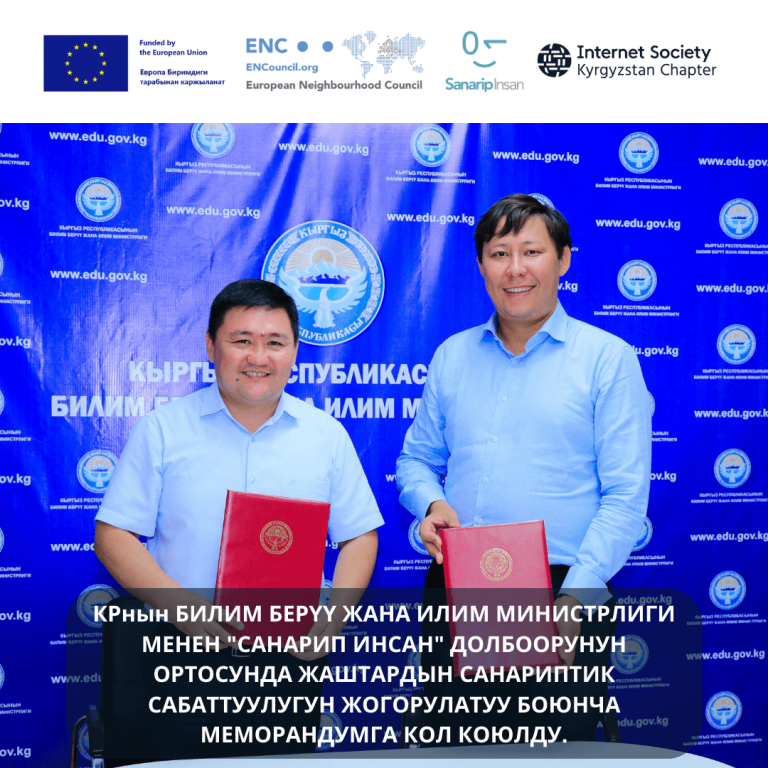
On July 20, 2023, “Sanarip Insan” project with the Ministry of Education and Science signed a memorandum to enhance the digital skills of youth in Kyrgyz Republic.
The signing ceremony was attended by Deputy Minister of Education and Science Bekzhan Supanaliev and co-founder of the “Internet Society Kyrgyzstan Chapter” and coordinator of the “Sanarip Insan” project Aziz Soltobayev.

Information technologies are taking an increasingly important place in our daily lives. Professions, especially in this field, are among the highest paid. To become a professional in this field, we must be digitally literate.

The lack of standardized exams contributes to our Kyrgyz-speaking students feeling disadvantaged because most of the training materials are in English and Russian.

In order to solve this problem, the Sanarip Insan project, on the recommendation of the Ministry of Education and Science of the Kyrgyz Republic, develops the Python programming course in Kyrgyz language.

More than 70 video tutorials and special materials have been created for young people who want to get acquainted with programming and determine their interests and opportunities in IT.

In addition, in order to increase the basic digital literacy of the population and on the basis of the memorandum, the project “Sanarip Insan”:

Adapts Microsoft’s Digital Literacy training course into Kyrgyz.

A “mobile internet skills training tool” tutorial will also be published.

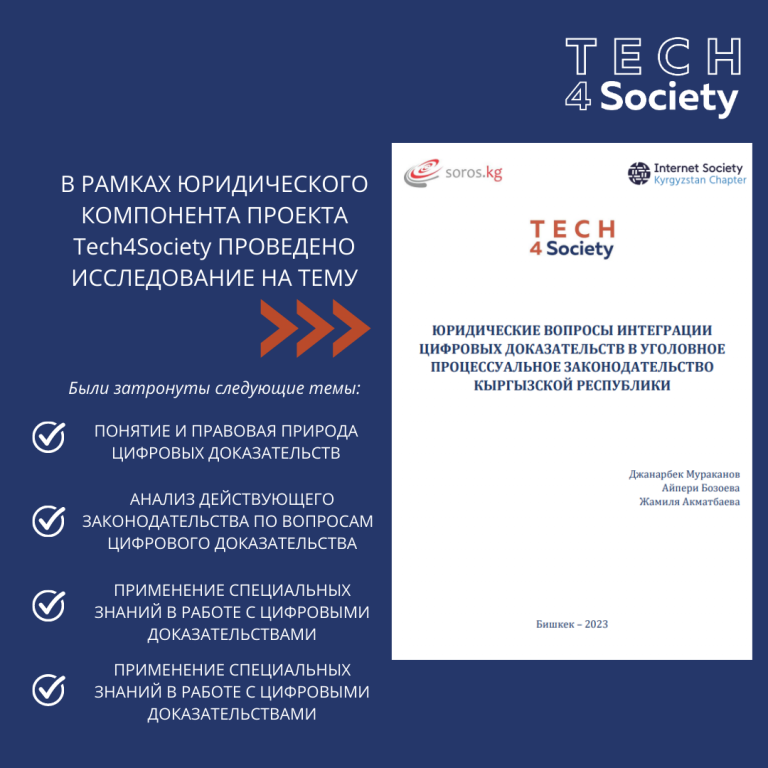
Legal Issues of Integrating Digital Evidence into the Criminal Procedural Legislation of the Kyrgyz Republic

The main objective of the research was a comprehensive study of the legal nature of digital evidence, their juridical significant features, as well as the formation of recommendations on their implementation in the criminal justice system of the Kyrgyz Republic in accordance with the Cyber Security Strategy.
To achieve this goal, the following tasks were set within the framework of this research:

1.studying the theoretical foundations of the concept and the legal nature of digital evidence, determining the legally significant features of digital evidence and generally recognized standards for their use;

2.analysis of the current criminal procedure legislation and law enforcement practice in criminal cases on the use of digital evidence;

3. studying the features of applying the special knowledge of a specialist and expert to work with digital evidence;

4. consideration of legal issues of integrating digital evidence into the criminal procedural legislation of the Kyrgyz Republic.

Within each of the above tasks, we provided a summary of key findings and conclusions, as well as recommendations for further consideration and implementation. As a practical result of the study, we have developed draft legal documents that are proposed for consideration by the relevant state bodies of the Kyrgyz Republic.

Based on the results of this study, we can state:

  1. Digital evidence is a legal term and characterizes the procedural and legal status of digital information.
  2. Digital information is a form of materialization of a person’s digital footprint in cyberspace.
  3. Digital evidence has a number of legally significant features (digital essence, abstractness, mediation, interpretability, fragility, unlimited copying, variety of forms, cross-border, qualified treatment).
  4. Internationally recognized standards for the use of digital evidence in the justice system include:
  • Ensuring the integrity and authenticity of digital evidence;
  • Documenting the process of working with digital evidence;
  • Support of specialists;
  • Qualification of bodies of inquiry;
  • Legal consistency.

In general, it should be noted that the technical means used in the justice system should serve the principles of individualization and personal nature of criminal liability and punishment (Articles 7 and 8 of the Criminal Code of the Kyrgyz Republic), not restrict a person’s freedom, but assist in proving circumstances of importance for the case, and the administration of justice within a particular case.

The integration of digital evidence into the criminal procedure legislation of the Kyrgyz Republic should be accompanied by the solution of a number of fundamental issues:

  • The Code of Criminal Procedure should define the place of digital evidence in the system of sources of evidence in a criminal case.
  • It is necessary to preserve and, in some cases, expand the effect of constitutional and legal guarantees of the inviolability of privacy in the course of criminal proceedings, including by strengthening the status of the investigating judge in matters of judicial control over the investigation.
  • It is necessary to legally correctly define the legal status, rights and obligations, as well as acceptable ways of communication with digital information providers, including those outside the jurisdiction of Kyrgyzstan.
  • Existing criteria for determining the admissibility of evidence should be supplemented by new criteria that apply exclusively to digital evidence.

Digital evidence can be introduced into the criminal procedure legislation of the Kyrgyz Republic through the adoption of 2 regulatory legal acts:

  • Law on Amendments and Additions to the Code of Criminal Procedure of the Kyrgyz Republic (creates a legal framework for the use of digital evidence)
  • Rules for the collection, seizure, storage and evaluation of digital evidence (govern the step-by-step actions of the persons involved in the collection, storage and examination of digital evidence).

By: Talant Sultanov, Zhanarbek Murakanov, Aiperi Bozoeva, Zhamilia Akmatbaeva, Nurbek Arzymbaev

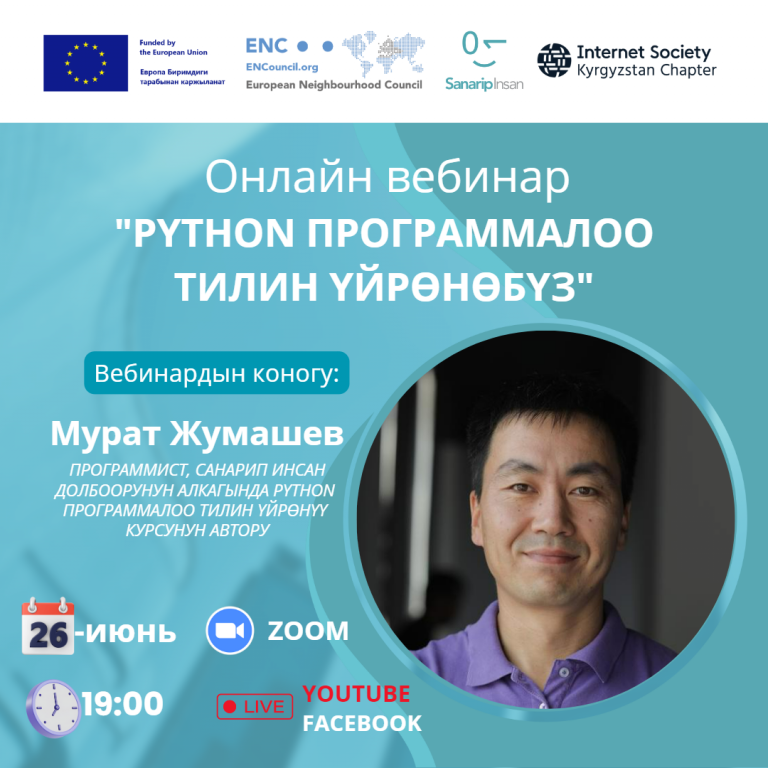
Learn the Python programming language

To this date, almost our entire life takes place online: we go shopping, learn, work and spend leisure time on the internet. That’s why IT specialists, often skilled in multiple programming languages, are in high demand.

If you’re unsure which programming language to choose from the multitude of available, we recommend participating in our webinar next monday. During the webinar, we will discuss the study of Python language, which has become the most used and easy to learn programming language in 2022. We’ll talk about the secrets behind Python’s popularity, its advantages and areas of application, and how it differs from other programming languages. 

The guest for the webinar will be Murat Zhumashev, the author of the Python programming language course for the “Sanarip Insan” project.

Internet Society Kyrgyzstan Chapter commits to mainstreaming digital skills of youth in the Kyrgyz Republic

Internet Society Kyrgyzstan Chapter is a non-profit organization founded in 2015 to support the development of the Internet as a global technical infrastructure, a resource to enrich people’s lives, and a force for good in society.
The organization helps to create community internet networks in remote mountainous areas of the country, develops edu-tech solutions to help youth access decent education, and conducts regular training for youth, women, and involved stakeholders to fulfill their mission.

Internet Society Kyrgyzstan Chapter’s commitment falls under its Sanarip Insan (Digital Citizen) project, which aims to empower women and youth in rural communities of the Kyrgyz Republic by improving their digital skills and increasing their employability in the green economy. Young people in rural areas will receive regional training on developing technical and vocational skills, ICT ,and soft skills.

In total 100, 000 young men and women between the ages of 15-29 residing in rural areas and young people with low levels of education and/or drop-outs will be benefited. The commitment will equip the youth with digital skills and basic digital literacy by March 2024. The project is funded by the European Union and implemented in partnership with the European Neighbourhood Council (Belgium).

In practice, the project will run entrepreneurship programs that combine different types of skills training – including “hard” and “soft” skills – with support services such as coaching and mentoring. The main scope of work is built on the following activities: Media campaigns with the involvement of local bloggers and popular social media media, digital literacy, and green skills development, ways to launch creative start-ups, methods to foster e-business models with small budgets and tips for raising initial capital through online and in-person training in different stages by digital leaders and experts.

Young women will be encouraged to engage and benefit from the digital economy through knowledge in e-commerce, digital tourism, e-agriculture, or e-business.

Internet Society Kyrgyzstan Chapter will contribute to the UN Sustainable Development Goals SDG5 (Gender Equality) and SDG8 (Decent work and economic growth).

The Global Initiative on Decent Jobs for Youth and the 2030 Agenda for Sustainable Development

Decent Jobs for Youth was launched in 2016 as a UN system-wide effort, focusing on the youth employment challenge that is central to the 2030 Agenda for Sustainable Development. It has emerged as a global, multi-stakeholder initiative that brings together governments, social partners, the private sector, youth and civil society organizations, and others. They work together to share knowledge, leverage resources and take action at country and regional level, to support young people in accessing decent work and productive employment worldwide. 

For more information, please contact:

Aziz Soltobaev, Project Coordinator, Internet Society Kyrgyzstan Chapter, [email protected]

Talant Sultanov, ICT Expert, Internet Society Kyrgyzstan Chapter, [email protected]

Global Initiative on Decent Jobs for Youth: [email protected]

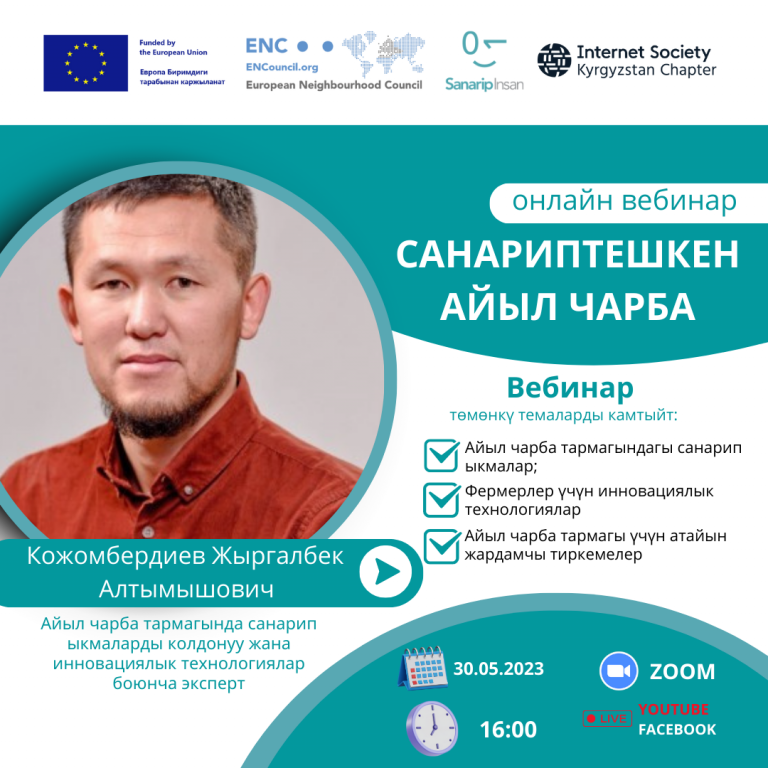
Online webinar “Digital agriculture”

Date: May 30

Time: 16:00

Speaker: Kozhomberdiev Zhyrgalbek Altymyshovich an expert on the use of digital methods and innovative technologies in agriculture of the public foundation “CAMP Alatoo”.
Kyrgyzstan has emerged as an agrarian nation, with a significant portion of its rural population engaged in animal husbandry and agriculture. Approximately 40 percent of the workforce is employed in the agricultural sector, which contributes to 20 percent of the country’s gross domestic product. In light of this, our upcoming webinar will focus on the subject of digital agriculture, as digitalization plays a vital role in the country’s overall development, particularly in the agricultural domain.

The modern agricultural revolution encompasses the integration of advanced information technologies (IT), which not only reduce manual labor and costs but also enhance productivity. Nowadays, computers are not the sole representatives of modern agricultural technologies. Digital advancements enable the comprehensive monitoring of the entire plant cultivation or animal husbandry process through “smart” devices that measure and transmit valuable data regarding soil conditions, vegetation growth, and microclimate. Additionally, mobile or online applications empower farmers and agronomists to determine the optimal time for planting or harvesting crops, calculate suitable fertilizer schemes, and even forecast future harvest yields.

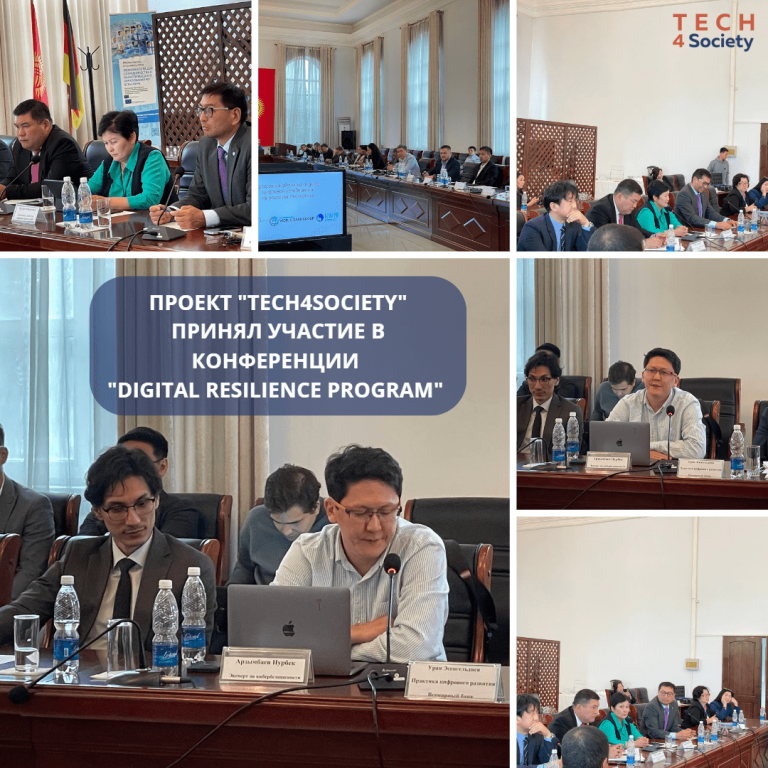
“Tech4Society project participates in international conference “Digital resilience program”

On May 18th, an international conference on “Digital Resilience Program: Completion and Next Steps” took place at the Kyrgyz State Technical University named after I. Razzakov.

The conference was attended by the Deputy Minister of Digital Development of the Kyrgyz Republic, Indira Sharshenova, the Head of the World Bank’s Office in the Kyrgyz Republic, Navid Hassan Nawki, as well as international organizations and experts in the field of digital technologies.

Also presenting at this event was the cybersecurity expert from the Tech4Society team, Nurbek Arzymbaev. In his speech, he emphasized the importance of developing national cybersecurity standards based on advanced international experience.