“Internet Society Kyrgyzstan Chapter”, with financial support from the U.S. Embassy in the Kyrgyz Republic, has begun training women in remote mountainous areas of the country in digital tourism to increase their digital literacy and promote their pursuit of economic prosperity.

The peculiarity of these trainings is the presence of trainers from different regions. In November 2023, trainers from 10 densely populated regions of our country were selected and had the opportunity to be trained by professional, experienced trainers in an offline format in Bishkek.
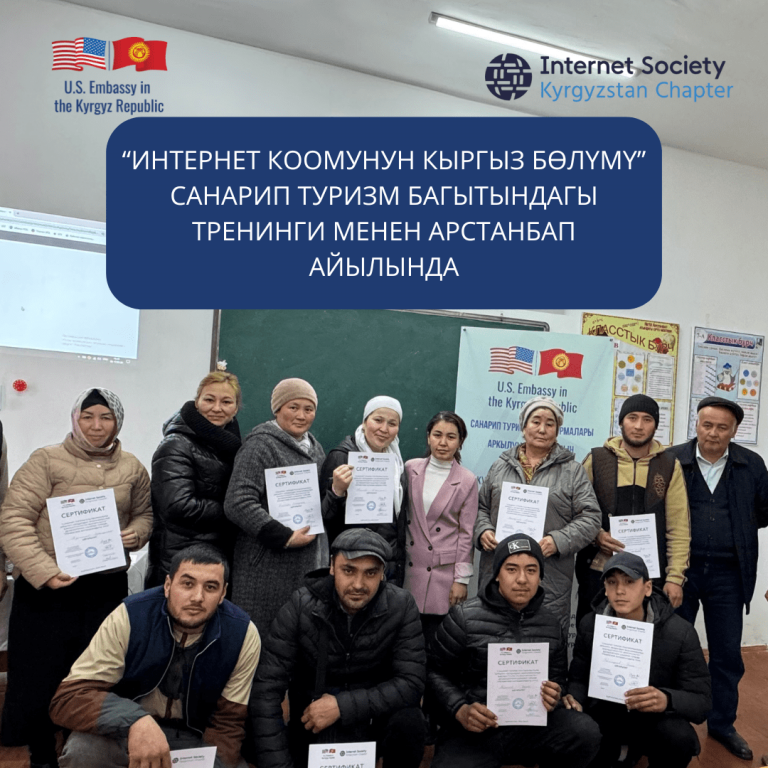
Offline trainings started on 10 March 2024 in the village of Arstanbap, Jalal-Abad region, with the participation of 20 local residents and guest house hosts who had the opportunity to improve their digital knowledge in tourism.
On the basis of the training, participants learnt the following skills: according to MISTT (Mobile Internet Skills Training Toolkit), the Mobile Internet Skills Training Toolkit, use social networks such as Instagram, Tik-Tok, Facebook, Google My Business, messengers WhatsApp, Telegram, Google Maps navigator in business, as well as register their guesthouses on travel platforms such as Booking. com, AirBnB, TripAdvisor, use automation systems for guesthouse management such as Shelter, PMS, edelweis, Fidelio. com, AirBnB, TripAdvisor, use guesthouse management automation systems such as Shelter, PMS, Edelweis, Fidelio.
The project aims to increase digital education of 500 women in remote mountainous areas of Kyrgyzstan over a period of 6 months.
The end result of the training is for women, youth, migrants and guesthouse owners in the regions to strive for an economically independent and prosperous life by learning and practising the correct use of digital platforms and skills in business.
As part of the global Internet Society initiative to promote community internet networks, we are pleased to announce that wired internet has become available in the remote mountainous settlement of Kyrchyn in the Naryn region. All the necessary technical work for laying optical fiber networks to the settlement has been completed.
Kyrchyn is a settlement consisting of 18 houses located in the Jumgal district, with approximately 100 residents. Today, high-speed internet has been introduced in every household in Kyrchyn, allowing residents to fully access internet services, and children to engage in remote learning when needed.
For 22 schoolchildren in Kyrchyn, who walk 3 km to school in neighbouring Aral, the arrival of the Internet was a great joy. While spring and autumn go to school without obstacles, winter conditions are severely frosty. The road to school follows a winding and uninhabited route, where wolves and wild animals have been observed. During the pandemic, everyone climbed the nearest mountain to catch the signal and download the necessary materials.
“Since the Internet became available, it has become much easier to learn. Because of the lack of books, we had to go to each other’s houses to do our homework. Nowadays, we can simply take a photo and send it through WhatsApp. My mom works and lives in Bishkek, and we missed her, but we couldn’t talk to her. Now we talk to her every day. And it has become easier for my brother, who has been working in Moscow for 5 years. Now we can talk to him at any time, and he can send money through the internet faster.”- said fifteen-year-old resident of the village of Kyrchyn Tahmina.
We visited the school in the village of Aral, where the children from Kyrchyn attend. As part of the “IlmBox” project, 100 books on ecology, IT, geography, inspirational literature, and books on improving mobile literacy using the GSMA Foundation Mobile Internet Skills Training Toolkit methodology were donated to the local library. This initiative aims to ensure that students and residents can derive maximum benefit and advantages from internet access.
The mission of the Internet Society Kyrgyzstan Chapter is to promote a healthy internet for all. ISOC Kyrgyz Chapter actively establishes and showcases sustainable models of community internet connections in Kyrgyzstan. We have already installed internet for communities in the Suusamyr Valley, where winter temperatures can drop to -50 degrees, and in Zardaly, a village in the Batken region, where people have to travel by foot and on donkeys for 5-8 hours, and where there is no electricity as well.
The project is funded by the Internet Society Foundation.
The penultimate visit was to the school Esimbekova (Tegizchil v.).
It is a compact school with 238 children. It is located on the outskirts of the village Tegizchil, however, despite this, at school we met a volunteer from the United States who came on a Peace Corps knowledge-sharing project.
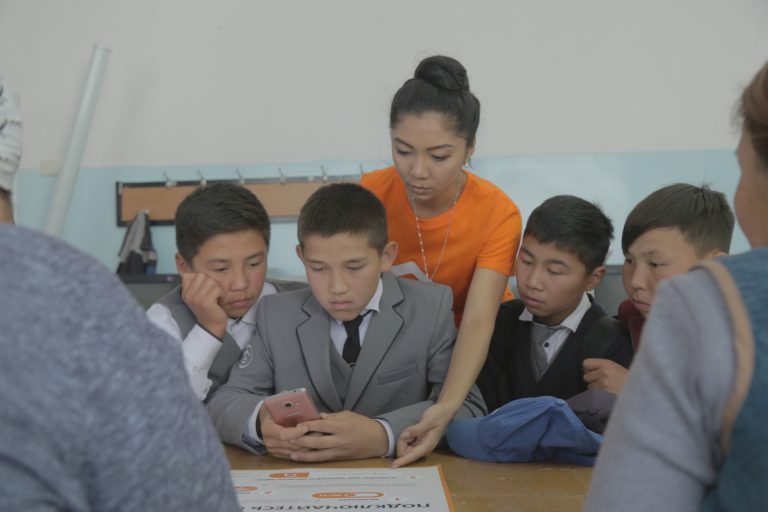
He teaches children English for the second academic year and speaks Kyrgyz perfectly.
Teachers and children admitted, in school except an office of administration there is no Internet access anywhere.
Of course such a gift to the school was very useful and also solved the problem of acute shortage of books.
The guys offered to install the device in the office of the school government, as it is usually open around the clock.
In the fifth school it was possible to meet not only teachers, but also pupils whom in school will count 268.
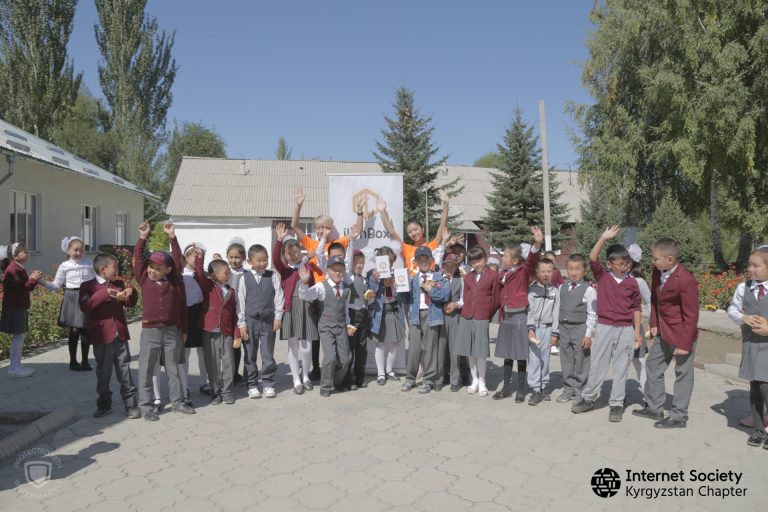
The presentation ilimBox called about ten active high school students and several teachers.
In this school, we noticed posters prohibiting the use of a mobile device at school, as in the classroom, children often use it for entertainment purposes.
We, in turn, have shown that with the advent of “IlimBox” smartphone can be used exclusively for educational purposes, and all this can be fun through video lessons.
On September 10-11, 2019, the ISOC team installed the electronic library “Ilim Box” in secondary schools in the southern part of Issyk-Kul region. The device allows you to access all educational resources without an Internet connection, in other words offline. Moreover, it is worth noting that all data is stored in the device itself, and only the power supply and the box itself are needed for connection. The uniqueness of the innovative project is that students can access educational resources at school without an Internet connection. Preparation for the trip took more than two weeks, because in addition to the presentation, the team has developed a new logo that reflects the essence of the project “Ilim Box”. Identification marks were made for the trip: branding boxes, roll-ups, spiders, t-shirts, stickers. The choice of schools was due to several factors: no access to the Internet for students, lack of books, as well as the number of students exceeded the permissible maximum, thereby increasing the likelihood of poor performance in schools without a network connection, as well as the choice of educational institutions influenced the list of proposed schools by the Ministry of education and science of the Kyrgyz Republic. The devices were donated: School № 10 Manas (Balykchy) School №7 (Balykchy) School B. Alakhov (Kara-Taala) School R. Jangaziev (Kara-Koo) School Erkinbaeva (Bar-Bulak) School-gymnasium №11 (Karakol) School Esimbekova (Tegizchil) School D. Turebekov (Boz-Bulun) In these schools was held a presentation of the project “Ilim box” then testing the device with students and teachers and handing the device. During the conversation, the importance of education and self-education were touched upon. Our visit to these schools has caused positive responses from the school administration, as none of them have access to the Internet for students, and most of them stressed the problem of not completing books in both Russian and Kyrgyz languages. It should be noted that in most of the rural schools it is forbidden to use a mobile phone on the territory of the educational institution, as teachers notice children’s gaming preferences during lessons. We showed the guys that with the advent of “Ilim box” smartphone can be used exclusively for educational purposes, and all this can be fun through video lessons. In Kyrgyzstan, there are more than 2,000 schools, among which there are those that do not have access to the Internet and do not have enough books. Accordingly, it affects the level of quality of education. In 2018, Kyrgyzstan declined to participate in the PISA world school rankings, as it was ranked last 65th in previous competitions. Innovative solutions to two pressing problems such as the lack of books and the lack of Internet can be seen in the project digital library for schools and public libraries “Ilim Box”, which contains Wikipedia in Kyrgyz, Russian and English, Khan Academy in English, thousands of video lessons, audio and e-books. All these digital learning materials are available offline, in other words does not need Internet access. Access to Digital libraries will be carried out through smartphones, tablets, computers and any other personal devices with Wi-Fi technology. “Ilim Box” will allow Kyrgyzstan to increase the level of education in the regions”, – said the Chairman of ISOC – Talant Sultanov, at the digital forum of Kazakhstan. Thus, visits to schools helped to identify several important points: need to develop a training manual on Kyrgyz language for better perception of information is needed in the formation of a database of electronic books, the materials should be in Russian and Kyrgyz languages, there is a need to create a list of the most useful books, and download online tests for the preparation to ORT. The goals and objectives of the project “Ilim Box” coincide with the five-year strategy of digital transformation “Digital Kyrgyzstan 2019-2023” and contribute to the achievement of target indicators for the component “development of the digital state” and “development of digital skills”. The project is funded by Alumni Engagement Innovation Fund 2018 (AEIF) as part of innovative solutions to global challenges and by program Beyond the Net ISOC.
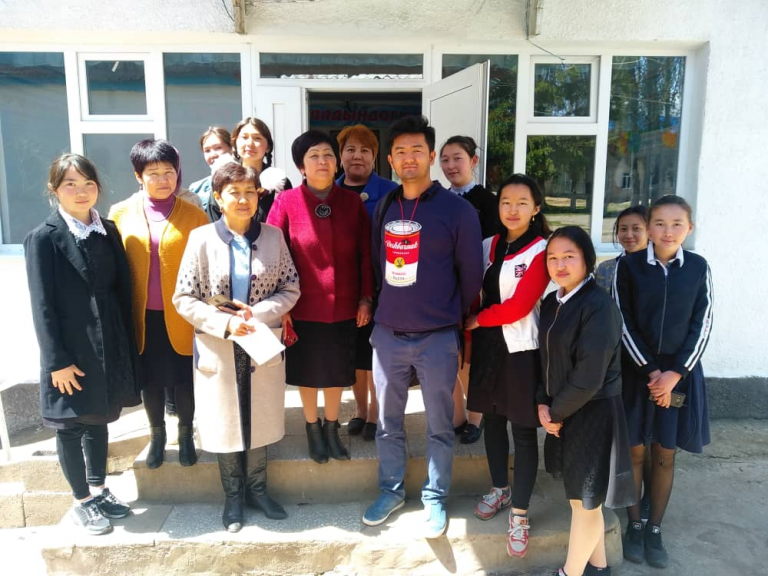
The project previously had various names “Internet in a box”, “Bilim Bulagy”, “Spring of Knowledge”and is not related to the World Bank project “Bilim Bulagy”.
On April 13, 2019, the ISOC team began installing the Bilim Bulagy electronic library. The device allows you to access all educational resources without an Internet connection, in other words offline. Moreover, it should be noted that all data is stored in the device itself, and only power supply and wireless modem are required for connection. The uniqueness of the innovative project is that students can access educational resources at school without an Internet connection.
The first schools where the trip was organized were the secondary school O. Isaeva (Kegety) and Chui boarding school (Tokmok) located in the Chui valley. The choice of schools was due to several factors: there is no access to the Internet, the number of students exceeded the allowable maximum, thereby increasing the likelihood of poor performance in schools without a network connection, as well as the choice of the above-described educational institutions was influenced by the interest Of the Association of young entrepreneurs “JIA” and the club of professionals “ProKG”, as they have a project “My school” with supervised schools.
For example, in high school O. Isaeva (Kegety) 511 students study, and the number of computers is equal to thirty-three, there is only one computer connected to the Internet. The second school is Chui boarding school (Tokmok), which has approximately the same performance. In these schools was held a presentation of the project “Internet in a box” then testing the device with students and teachers. During the conversation, the importance of education and self-education were touched upon.
The third school was in S. Boroldai of Kemin district of Chui region. The plan of the meeting was built in the same way. Since the school is Russian-speaking, the appeal of teachers was aimed at increasing the materials in Russian, which would greatly facilitate the process of knowledge transfer.
There are more than 2,000 schools in Kyrgyzstan, some of which do not have access to the Internet and lack books. Accordingly, it affects the level of quality of education. In 2018, Kyrgyzstan declined to participate in the PISA world school rankings, as it was ranked last 65th in previous competitions.
Innovative solutions to two pressing problems such as the lack of books and the lack of the Internet can be seen in the project “Bilim Bulagy” (Internet in a box) – a digital library for schools and public libraries containing Wikipedia in Kyrgyz, Russian and English languages, Khan Academy, thousands of video lessons, audio and e-books. All these digital learning materials are available offline, in other words does not need Internet access. Access to Digital libraries will be carried out through smartphones, tablets, computers and any other personal devices with Wi-Fi technology.
“Bilim Bulagy will allow Kyrgyzstan to improve the level of education in the regions”, – said the Chairman of ISOC – Talent Sultanov, at the digital forum of Kazakhstan.
Thus, visits to schools helped to identify several important points: it is necessary to develop a manual in the Kyrgyz language for better perception of information, there is a need in the formation of the database of electronic books, materials should be both in Russian and in Kyrgyz, there is a need to create a list of the most necessary books. The goals and objectives of the project “Bilim Bulagy” coincide with the five-year strategy of digital transformation “Digital Kyrgyzstan 2019-2023” and contribute to the achievement of target indicators for the component “development of the digital state” and “development of digital skills”.
The project is funded by Alumni Engagement Innovation Fund 2018 (AEIF) as part of innovative solutions to global challenges.
ISOC Kyrgyz Chapter is implementing one of its first major projects thanks to Beyond the Net grant from ISOC. Ferghana Valley Internet Exchange Point (FVIXP) Project will install an IXP in Osh city in the south of Kyrgyzstan, which will result in a much cheaper internet for all the residents of Ferghana Valley.

Ferghana Valley located on crossroads of three countries is the most populated area in Central Asia, the source of regional inter-ethnic tensions due to water and land irrigation disputes, poverty and lack of access to communication services. Internet Exchange Point Project with location in Osh city (Kyrgyzstan) is aimed to increase regional cross-border collaboration between stakeholders and communication of people through increase of Internet affordability by lowering internet tariff plans up to 3 times, multiply growth of Internet traffic exchange in region, increase Internet penetration rate due to price reduction, and improve latency for international and regional content sources.
Ferghana Valley located at the crossroads of three countries of Central Asia: Kyrgyzstan, Uzbekistan, and Tajikistan are in top 10 regions with highest population density in the world. Over 14 million people (2014) reside in 22,000 square kilometers (approximately 636 persons per square km). The region is known for land and water disputes, inter-ethnic conflicts. There is a huge income disparity between administrative capitals of the Stans and regional dwelling communities in Ferghana Valley.
Central Asia has one of the lowest internet penetration rates per capita in Europe and Central Asian region, according to ITU 2014. One of the key regions that illustrate state of the regional digital divide is Ferghana Valley. In regional perspective Internet prices for Ferghana valley dwellers are higher than for residents of other administrative districts. For example, Internet tariff plans in southern cities are 5 times higher (13USD) for the same traffic bandwidth than that in Bishkek located in the North of Kyrgyzstan. Tajikistan, which primarily depends on Internet transit of Russian content from Kyrgyzstan, has an even more severe situation. National ISP Tojnet provides 1Mb unlimited tariff for as low as 45USD. The situation in Uzbekistan is even worse. Uzbekistan ISP monopoly company provides Internet in cities located in Ferghana valley for the price of 59USD for 10GB of the daily Internet and unlimited night traffic.
Considering above mentioned situation we believe establishing Internet Exchange Point in the valley will alleviate the digital divide between the north and south of Kyrgyzstan as well as between the bordering countries by removing barriers for connectivity and stimulating better access.
Internet Exchange Point is a physical location where different stakeholders who have ASN meet to exchange local traffic via a switch. Kyrgyzstan is one of the countries where Ferghana Valley is spread. There are several closed IXPs based in Bishkek (ISP, banks). Unlike present IXPs that could not be neutral and open for new members by Charter, Ferghana Valley IXP (FVIXP) will follow principles of openness and neutrality by providing equal access to infrastructure to all stakeholders, including Government agencies, educational and healthcare institutions as well as commercial banks. IXP will help local small and medium ISP to minimize traffic costs, spend more on infrastructure rather than on internet traffic purchase.
Establishing IXP would greatly enhance the utility and value of the regional Internet and promote the growth of the digital economy. According to Terabit Consulting, “Improvement in ICT infrastructure yields: Increased demand for the output of other industries (demand multiplier), New opportunities for production in other industries (supply multiplier), new goods and services for consumers (final demand). It also increases firms’ innovation capabilities and increases the probability of new products, innovations, and organizations.”