“Internet Society Kyrgyz Chapter” to train 500 women in digital skills for tourism development

”Кыргызское Отделение Интернет Общества“ при финансовой поддержке посольства США в Кыргызской Республике начало обучение женщин в отдаленных горных районах страны по направлению ” Цифровой туризм ” с целью повышения их цифровой грамотности и содействия их стремлению к экономическому благополучию.

Особенностью этих тренингов является наличие тренеров из разных регионов. 2023 г. в ноябре прошли отбор тренеры из 10 густонаселенных регионов нашей страны, которые имели возможность пройти обучение у профессиональных, опытных тренеров в оффлайн формате в городе Бишкек.

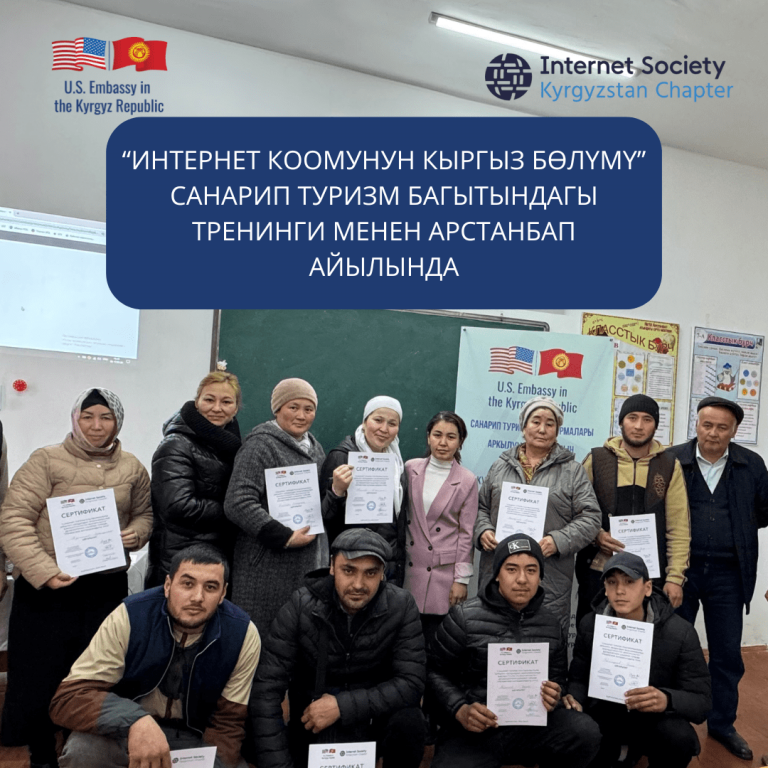
Тренинги, проводимые в оффлайн формате, стартовали 10 марта 2024 года в селе Арстанбап Джалал-Абадской области, в них приняли участие 20 местных жительниц и хозяек гостевых домов, которые получили возможность повысить свои цифровые знания в сфере туризма.

На основе обучения участники овладели следующими навыками: в соответствии с MISTT (Mobile Internet Skills Training Toolkit), Инструментарий по Обучению навыкам мобильного Интернета использование социальных сетей, таких как Instagram, Tik-Tok, Facebook, Google My Business, мессенджеров WhatsApp, Telegram, навигатора Google Maps в бизнесе, а также освоили регистрировать свои гостевые дома на туристических платформах как: Booking.com,  AirBnB, TripAdvisor, использовать системы автоматизации управления гостевыми домами, такие как Shelter, PMS, Edelweis, Fidelio.

Целью проекта является повышение цифрового образования 500 женщин в отдаленных горных районах Кыргызстана в течение 6 месяцев.

Конечным результатом обучения является стремление женщин, молодежи, мигрантов и владельцев гостевых домов в регионах к экономически независимой и процветающей жизни, обучаясь и практикуя правильное использование цифровых платформ и навыков в бизнесе.

In the remote settlement of Kyrchyn in the Naryn region, wired internet has become available

В рамках глобальной инициативы Интернет Общества по продвижению общинных интернет сетей, мы рады сообщить, что в отдаленном горном населенном пункте Кырчын Нарынской области появился проводной интернет. Все необходимые технические работы по прокладке оптиковолоконных сетей до населенного пункта проведены.

Кырчын – населенный пункт в 18 домов в Жумгальском районе, где проживают около 100 человек. Сегодня в каждом доме Кырчына появился скоростной интернет, жители имеют возможность полноценно пользоваться услугами в интернете, а дети – учиться дистанционно при необходимости.

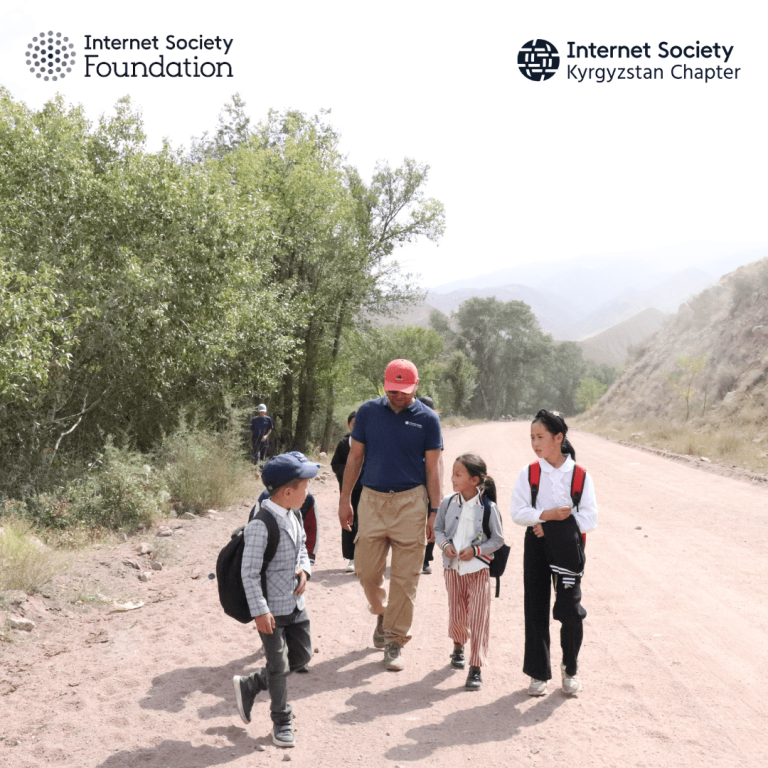
Для 22 школьников Кырчына, которые ходят в школу в соседний Арал за 3 км пешком, появление интернета стало большой радостью. Если весной и осенью ходят в школу без препятствий, то зимой суровые морозные условия. Дорога до школы проходит по извилистой ненаселенной проезжей дороге, где замечали волков, диких животных. Во время пандемии все поднимались на ближайшую гору чтобы поймать сигнал и скачивать необходимые материалы.

«С тех пор как появился Интернет, стало намного проще учиться. Из-за нехватки книг нам приходилось ходить друг к другу, чтобы сделать домашнюю работу. Сейчас мы можем просто сфотографировать и отправить через ватсап. Моя мама работает и живет в Бишкеке, мы скучали по ней, но не могли поговорить. Теперь мы каждый день разговариваем с ней. И брату, который уже 5 лет работает в Москве, стало легче. Мы теперь и с ним можем говорить в любое время, и деньги он может отправлять через интернет быстрее», – рассказала 15-летняя Тахмина, жительница Кырчына.

Мы посетили школу в селе Арал, где учатся дети Кырчына. В рамках проекта «ИлимБокс» подарили местной библиотеке 100 книг по экологии, ИТ, географии, вдохновляющие, а также книги по повышению уровня мобильной грамотности по методологии GSMA Foundation Mobile Internet Skills Training Toolkit, чтобы школьники и жители могли получать максимум пользы и выгод от доступа к Интернету.

Миссией Internet Society Kyrgyzstan Chapter является здоровый Интернет для Всех. Айсок активно устанавливает и демонстрирует устойчивые модели общинных интернет соединений в Кыргызстане. Мы уже устанавливали Интернет для сообществ в Суусамырской долине где зимой температура доходит до 50 градусов, и в Зардалы, село в Баткенской области куда приходится добираться пешком и на осликах по 5-8 часов, где также нет электричества.

Проект финансируется Internet Society Foundation.


School of Eshimbekova (Tegizchil v., Issyk-Kul region)

The penultimate visit was to the school Esimbekova (Tegizchil v.).

It is a compact school with 238 children.  It is located on the outskirts of the village Tegizchil, however, despite this, at school we met a volunteer from the United States who came on a Peace Corps knowledge-sharing project.
He teaches children English for the second academic year and speaks Kyrgyz perfectly.

Teachers and children admitted, in school except an office of administration there is no Internet access anywhere.

Of course such a gift to the school was very useful and also solved the problem of acute shortage of books.

The guys offered to install the device in the office of the school government, as it is usually open around the clock.

School of Ekinbaeva (Bar-Bulak v., Issyk-Kul region)

In the fifth school it was possible to meet not only teachers, but also pupils whom in school will count 268.
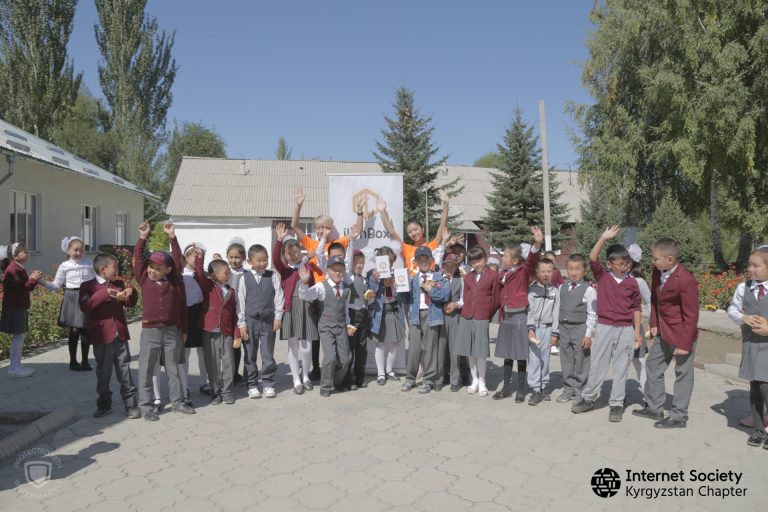
The presentation ilimBox called about ten active high school students and several teachers.

In this school, we noticed posters prohibiting the use of a mobile device at school, as in the classroom, children often use it for entertainment purposes.

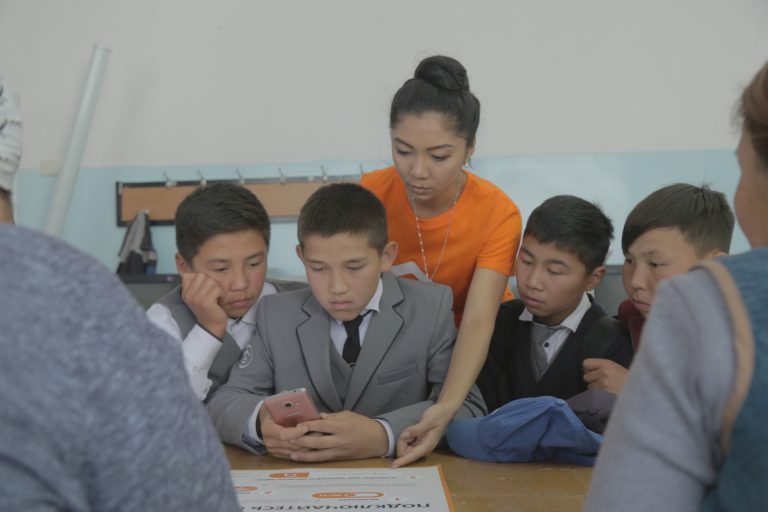
We, in turn, have shown that with the advent of “IlimBox” smartphone can be used exclusively for educational purposes, and all this can be fun through video lessons.

The electronic library “Ilim Box” in the southern part of Issyk-Kul region

On September 10-11, 2019, the ISOC team installed the electronic library “Ilim Box” in secondary schools in the southern part of Issyk-Kul region. The device allows you to access all educational resources without an Internet connection, in other words offline. Moreover, it is worth noting that all data is stored in the device itself, and only the power supply and the box itself are needed for connection. The uniqueness of the innovative project is that students can access educational resources at school without an Internet connection.
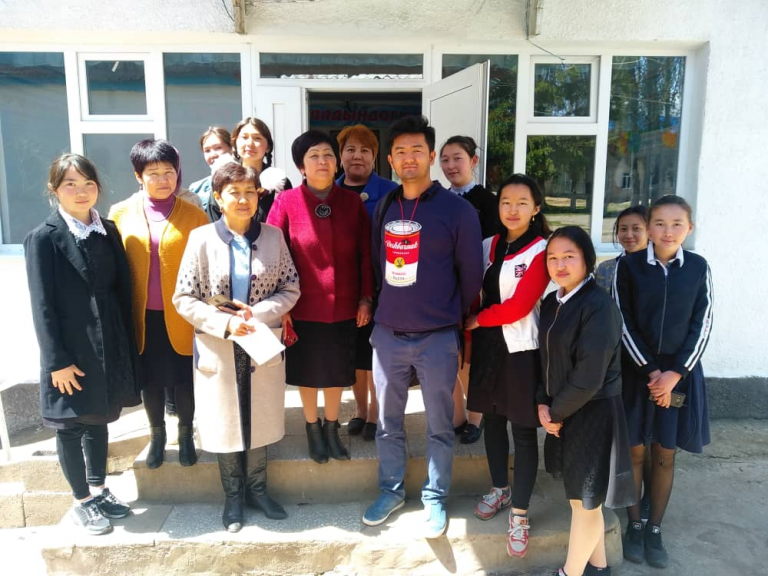
Preparation for the trip took more than two weeks, because in addition to the presentation, the team has developed a new logo that reflects the essence of the project “Ilim Box”. Identification marks were made for the trip: branding boxes, roll-ups, spiders, t-shirts, stickers.
The choice of schools was due to several factors: no access to the Internet for students, lack of books, as well as the number of students exceeded the permissible maximum, thereby increasing the likelihood of poor performance in schools without a network connection, as well as the choice of educational institutions influenced the list of proposed schools by the Ministry of education and science of the Kyrgyz Republic.
The devices were donated:
School № 10 Manas (Balykchy)
School №7 (Balykchy)
School B. Alakhov (Kara-Taala)
School R. Jangaziev (Kara-Koo)
School Erkinbaeva (Bar-Bulak)
School-gymnasium №11 (Karakol)
School Esimbekova (Tegizchil)
School D. Turebekov (Boz-Bulun)
In these schools was held a presentation of the project “Ilim box” then testing the device with students and teachers and handing the device. During the conversation, the importance of education and self-education were touched upon. Our visit to these schools has caused positive responses from the school administration, as none of them have access to the Internet for students, and most of them stressed the problem of not completing books in both Russian and Kyrgyz languages. It should be noted that in most of the rural schools it is forbidden to use a mobile phone on the territory of the educational institution, as teachers notice children’s gaming preferences during lessons. We showed the guys that with the advent of “Ilim box” smartphone can be used exclusively for educational purposes, and all this can be fun through video lessons.
In Kyrgyzstan, there are more than 2,000 schools, among which there are those that do not have access to the Internet and do not have enough books. Accordingly, it affects the level of quality of education. In 2018, Kyrgyzstan declined to participate in the PISA world school rankings, as it was ranked last 65th in previous competitions.
Innovative solutions to two pressing problems such as the lack of books and the lack of Internet can be seen in the project digital library for schools and public libraries “Ilim Box”, which contains Wikipedia in Kyrgyz, Russian and English, Khan Academy in English, thousands of video lessons, audio and e-books. All these digital learning materials are available offline, in other words does not need Internet access. Access to Digital libraries will be carried out through smartphones, tablets, computers and any other personal devices with Wi-Fi technology.
“Ilim Box” will allow Kyrgyzstan to increase the level of education in the regions”, – said the Chairman of ISOC – Talant Sultanov, at the digital forum of Kazakhstan.
Thus, visits to schools helped to identify several important points: need to develop a training manual on Kyrgyz language for better perception of information is needed in the formation of a database of electronic books, the materials should be in Russian and Kyrgyz languages, there is a need to create a list of the most useful books, and download online tests for the preparation to ORT. The goals and objectives of the project “Ilim Box” coincide with the five-year strategy of digital transformation “Digital Kyrgyzstan 2019-2023” and contribute to the achievement of target indicators for the component “development of the digital state” and “development of digital skills”.
The project is funded by Alumni Engagement Innovation Fund 2018 (AEIF) as part of innovative solutions to global challenges and by program
Beyond the Net ISOC.

The project previously had various names “Internet in a box”, “Bilim Bulagy”, “Spring of Knowledge”and is not related to the World Bank project “Bilim Bulagy”.

Connecting schools to Ilimbox aka Bilim Bulagy

On April 13, 2019, the ISOC team began installing the Bilim Bulagy electronic library. The device allows you to access all educational resources without an Internet connection, in other words offline. Moreover, it should be noted that all data is stored in the device itself, and only power supply and wireless modem are required for connection. The uniqueness of the innovative project is that students can access educational resources at school without an Internet connection.  
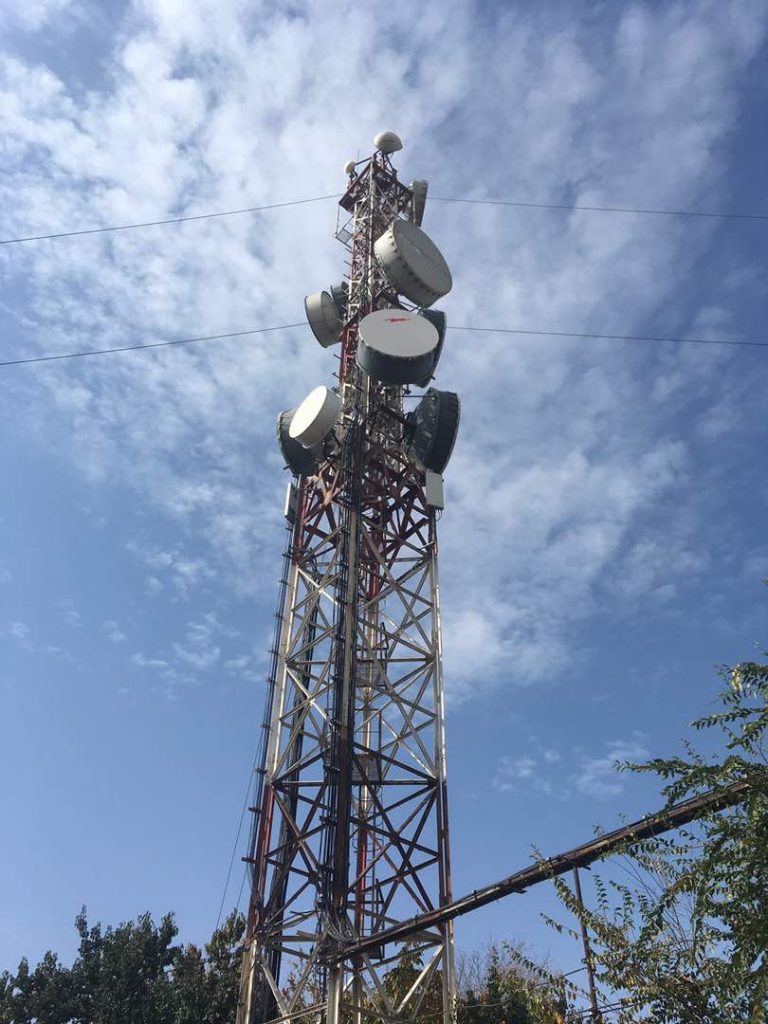
The first schools where the trip was organized were the secondary school O. Isaeva (Kegety) and Chui boarding school (Tokmok) located in the Chui valley. The choice of schools was due to several factors: there is no access to the Internet, the number of students exceeded the allowable maximum, thereby increasing the likelihood of poor performance in schools without a network connection, as well as the choice of the above-described educational institutions was influenced by the interest Of the Association of young entrepreneurs “JIA” and the club of professionals “ProKG”, as they have a project “My school” with supervised schools.

For example, in high school O. Isaeva (Kegety) 511 students study, and the number of computers is equal to thirty-three, there is only one computer connected to the Internet. The second school is Chui boarding school (Tokmok), which has approximately the same performance. In these schools was held a presentation of the project “Internet in a box” then testing the device with students and teachers. During the conversation, the importance of education and self-education were touched upon.  

The third school was in S. Boroldai of Kemin district of Chui region. The plan of the meeting was built in the same way. Since the school is Russian-speaking, the appeal of teachers was aimed at increasing the materials in Russian, which would greatly facilitate the process of knowledge transfer.

There are more than 2,000 schools in Kyrgyzstan, some of which do not have access to the Internet and lack books. Accordingly, it affects the level of quality of education. In 2018, Kyrgyzstan declined to participate in the PISA world school rankings, as it was ranked last 65th in previous competitions.

Innovative solutions to two pressing problems such as the lack of books and the lack of the Internet can be seen in the project “Bilim Bulagy” (Internet in a box) – a digital library for schools and public libraries containing Wikipedia in Kyrgyz, Russian and English languages, Khan Academy, thousands of video lessons, audio and e-books. All these digital learning materials are available offline, in other words does not need Internet access. Access to Digital libraries will be carried out through smartphones, tablets, computers and any other personal devices with Wi-Fi technology.

“Bilim Bulagy will allow Kyrgyzstan to improve the level of education in the regions”, – said the Chairman of ISOC – Talent Sultanov, at the digital forum of Kazakhstan.

Thus, visits to schools helped to identify several important points: it is necessary to develop a manual in the Kyrgyz language for better perception of information, there is a need in the formation of the database of electronic books, materials should be both in Russian and in Kyrgyz, there is a need to create a list of the most necessary books. The goals and objectives of the project “Bilim Bulagy” coincide with the five-year strategy of digital transformation “Digital Kyrgyzstan 2019-2023” and contribute to the achievement of target indicators for the component “development of the digital state” and “development of digital skills”.

The project is funded by Alumni Engagement Innovation Fund 2018 (AEIF) as part of innovative solutions to global challenges.


Ferghana Valley IXP

ISOC Kyrgyz Chapter is implementing one of its first major projects thanks to Beyond the Net grant from ISOC. Ferghana Valley Internet Exchange Point (FVIXP) Project will install an IXP in Osh city in the south of Kyrgyzstan, which will result in a much cheaper internet for all the residents of Ferghana Valley.

Ferghana Valley located on crossroads of three countries is the most populated area in Central Asia, the source of regional inter-ethnic tensions due to water and land irrigation disputes, poverty and lack of access to communication services. Internet Exchange Point Project with location in Osh city (Kyrgyzstan) is aimed to increase regional cross-border collaboration between stakeholders and communication of people through increase of Internet affordability by lowering internet tariff plans up to 3 times, multiply growth of Internet traffic exchange in region, increase Internet penetration rate due to price reduction, and improve latency for international and regional content sources.

Ferghana Valley located at the crossroads of three countries of Central Asia: Kyrgyzstan, Uzbekistan, and Tajikistan are in top 10 regions with highest population density in the world. Over 14 million people (2014) reside in 22,000 square kilometers (approximately 636 persons per square km). The region is known for land and water disputes, inter-ethnic conflicts. There is a huge income disparity between administrative capitals of the Stans and regional dwelling communities in Ferghana Valley.

Central Asia has one of the lowest internet penetration rates per capita in Europe and Central Asian region, according to ITU 2014. One of the key regions that illustrate state of the regional digital divide is Ferghana Valley. In regional perspective Internet prices for Ferghana valley dwellers are higher than for residents of other administrative districts. For example, Internet tariff plans in southern cities are 5 times higher (13USD) for the same traffic bandwidth than that in Bishkek located in the North of Kyrgyzstan. Tajikistan, which primarily depends on Internet transit of Russian content from Kyrgyzstan, has an even more severe situation. National ISP Tojnet provides 1Mb unlimited tariff for as low as 45USD. The situation in Uzbekistan is even worse. Uzbekistan ISP monopoly company provides Internet in cities located in Ferghana valley for the price of 59USD for 10GB of the daily Internet and unlimited night traffic.

Considering above mentioned situation we believe establishing Internet Exchange Point in the valley will alleviate the digital divide between the north and south of Kyrgyzstan as well as between the bordering countries by removing barriers for connectivity and stimulating better access.

Internet Exchange Point is a physical location where different stakeholders who have ASN meet to exchange local traffic via a switch. Kyrgyzstan is one of the countries where Ferghana Valley is spread. There are several closed IXPs based in Bishkek (ISP, banks). Unlike present IXPs that could not be neutral and open for new members by Charter, Ferghana Valley IXP (FVIXP) will follow principles of openness and neutrality by providing equal access to infrastructure to all stakeholders, including Government agencies, educational and healthcare institutions as well as commercial banks. IXP will help local small and medium ISP to minimize traffic costs, spend more on infrastructure rather than on internet traffic purchase.

Establishing IXP would greatly enhance the utility and value of the regional Internet and promote the growth of the digital economy. According to Terabit Consulting, “Improvement in ICT infrastructure yields: Increased demand for the output of other industries (demand multiplier), New opportunities for production in other industries (supply multiplier), new goods and services for consumers (final demand). It also increases firms’ innovation capabilities and increases the probability of new products, innovations, and organizations.”