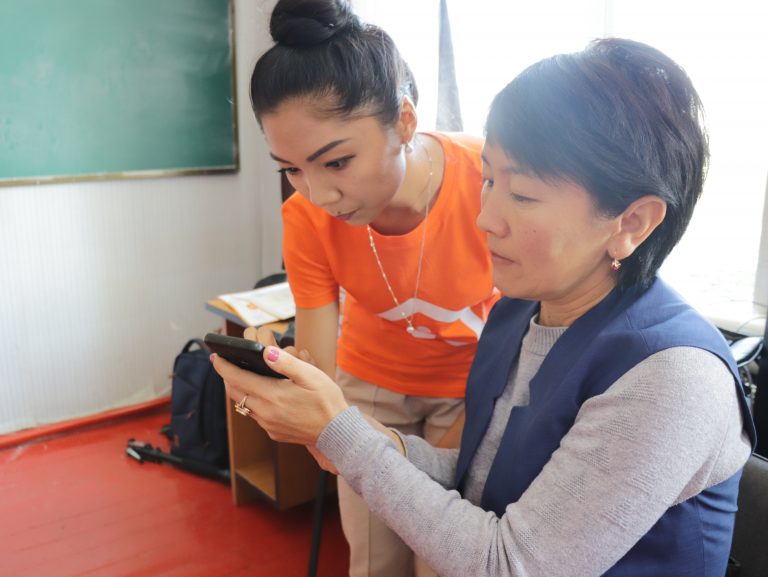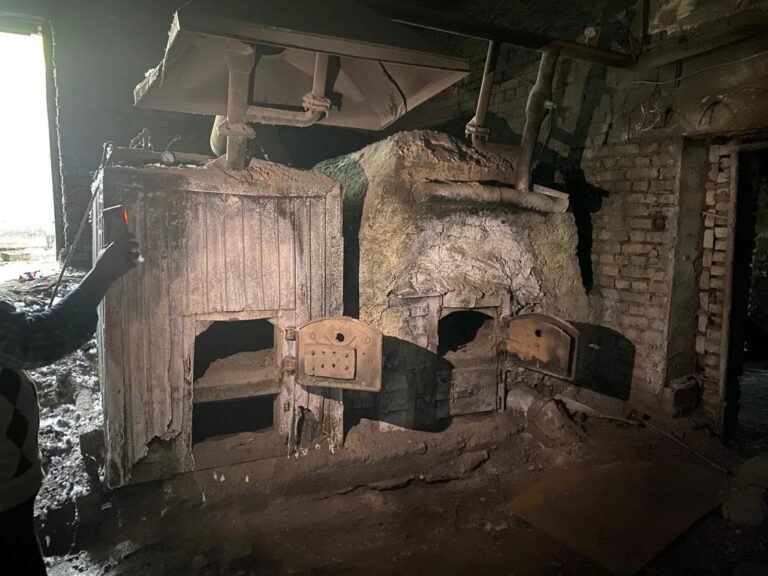
Өзгөн районундагы Кара-Дыйкана айылындагы орто мектепке инновациялык күл чогултуучу орнотулду.

In secondary school No. 7 named after Tagay Tashmamatov, located in the village of Kara-dyikan, Uzgen district, Osh region, an innovative industrial ash filter for a coal furnace was installed, which retains up to 98% of harmful substances and carbon dioxide. Thanks to the introduction of these green technologies, schoolchildren, teachers and residents of nearby houses can be protected from the negative health consequences of emissions of harmful substances from coal furnaces during winter heating seasons.

In the process of monitoring the quality of the network Internet infrastructure, the project team paid attention to the heating systems in pilot schools. Almost all schools in rural areas are heated by coal furnaces installed 50-60 years ago, which are significantly inferior in energy efficiency and safety to modern coal furnaces and alternative heating methods. Particular attention was drawn to the coal furnace of the secondary school in the village of Kara-dyikan, Uzgen district, Osh region. This coal furnace was located in the basement under the floors where students study during the day. Even in the spring, it was difficult to enter and stay in this room due to the high content of harmful substances and the smell of coal ash. The team found it difficult to imagine how it works in the winter and how children study while smelling the ash that penetrated the classrooms through the floor and windows.

The school administration repeatedly contacted local government bodies and the leadership of the Ministry of Education of the Kyrgyz Republic. However, these issues remained open and were not a priority. About 1,500 students study at this school, and the total number of residents in the village of Kara-Dyikan, according to the census, was 7,700 people. During the same period in Kyrgyzstan, engineer Amantur Salymbaev invented an innovative filter for coal furnaces, which cyclone and electromagnetic filters trap 90% of harmful particles and do not allow 50% of carbon dioxide. The filter does not need electricity or water to operate. According to the Ministry of Natural Resources, its efficiency in air purification reaches 98%. At the time of the appeal, Salymbaev had a patent for a technical invention and began to offer implementation. The filter is designed for a service life of 5-6 years and does not require maintenance. This makes the device a sustainable and cost-effective solution. In this regard, this project financed the installation of this filter at the school. The initiative to install an innovative filter received support from the school administration and local government. The industrial filter was developed within a few days, and the installation took two days. We hope that this measure will contribute to the health of the residents of this village, students and teachers of the school, and also become an exemplary model for other schools in the Kyrgyz Republic.

You could learn more about innovative solution following the link: https://www.instagram.com/reel/DI3oZeNMBVY/ 

School of Eshimbekova (Tegizchil v., Issyk-Kul region)

The penultimate visit was to the school Esimbekova (Tegizchil v.).

It is a compact school with 238 children.  It is located on the outskirts of the village Tegizchil, however, despite this, at school we met a volunteer from the United States who came on a Peace Corps knowledge-sharing project.

He teaches children English for the second academic year and speaks Kyrgyz perfectly.

Teachers and children admitted, in school except an office of administration there is no Internet access anywhere.

Of course such a gift to the school was very useful and also solved the problem of acute shortage of books.

The guys offered to install the device in the office of the school government, as it is usually open around the clock.

Launch of the Suusamyr Net Community Network

On November 23, 2018, with the support of the Internet Society in the village of Suusamyr, Chui oblast, the project “Suusamyr Net” was launched.
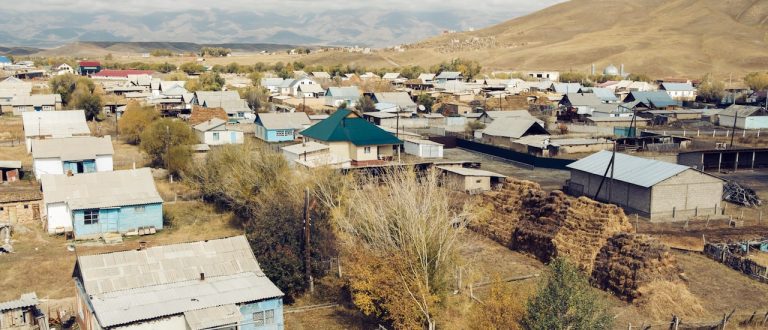
This initiative aims to provide Internet access to residents of the Suusamyr Valley, expanding opportunities and increasing access to information.

In a mountainous country, more than half of the population lives far from big cities and modern technologies. Less than 40 percent of the country’s population has access to the Internet. Such a project allows realizing the idea of digital transformation of the country.

Internet Society began work on the promotion of the Internet in the remote villages of the country in 2017. A round table was held on the Internet connection in remote areas of Kyrgyzstan. This project is the first of its kind in Central Asia. Building a public Internet provider in the village of Suusamyr will also allow you to gain experience in connecting remote areas and help identify obstacles to creating public providers. The budget of the pilot project in Suusamyr is $ 35,000 provided by the Internet grant program of the Society “Beyond the Net”.

This pilot project consists of two phases:

1. Conducting the Internet in the village Suusamyr.
The optimal solution for the implementation of the first stage was the use of radio relay transmitters.
At a distance of 23 km from the village there is a connection point (gas station Gazprom) to the fiber-optic highway Elkat. Due to the lack of direct visibility, the radio bridge was built of two spans.
The first span from the gas station Gazprom to Tokiluu, distance 6km.
Second span from Tokiluu to Suusamyr 18km distance.
At the moment, it was possible to achieve a channel with 90 Mbps speed. In the future it is planned to double the width of the channel.

2. Construction of a network inside the village.
The Community Network infrastructure is based on GEPON technology. The main feature is high – connection speed, up to 1000 Mbps. Such a reserve of speed will allow to delay the need to upgrade equipment for many years, providing an extremely high level of services.

Local residents were involved in the construction of the network. So welders for metal welded fixtures on which wires were hung. Local electricians hung fiber optic cables on power poles. Several people were trained to work with a special welding machine for optical fiber and work with subscriber equipment.

Preliminary results of the project:
The use of modern technology has reduced the cost of the project. The involvement of local people in the creation of a community network has strengthened the future of the project.
So the subscriber connection is 4000 soms, which is equal to the cost of equipment and necessary work.
The monthly fee is 650 soms with a tariff of 5 Mbps for the first 50 subscribers. The network is capable of receiving up to 250 subscribers. With an increase in subscribers, the monthly subscription fee will significantly decrease, dividing all monthly network expenses equally among subscribers.

At the request of residents, it is also planned to introduce the possibility of connecting IP television with 100 channels, which will cost an additional 200 soms per month, and the purchase of a TV box for 2000 soms will be necessary.

After the successful launch of a Community Network in the village of Suusamyr, the project will be scaled to all regions of the country. This will include training of interested communities on the example of a pilot project, assistance in designing, building and launching Community Networks.

For more information on the project you can contact the coordinators:
Erzhigit Imamov responsible for the technical part of the project.
[email protected], +996779880422.
Isabek Asanbayev project coordinator [email protected], +996556552247.

Learning by Doing: Have You Heard of the Suusamyr Community Network in Kyrgyzstan?

Last week, the Internet Society together with our Kyrgyz chapter and the wider local community held discussions about Internet connectivity in remote areas in Bishkek, Kyrgyzstan. Approximately 35% of the Kyrgyz population use the Internet (ITU data, 2017) and most users are located in cities and urban areas.

In cooperation with its Kyrgyz chapter, the Internet Society is piloting the community networks approach in the village of Suusamyr, located some 150 kilometers south of the capital city Bishkek. We had an opportunity to visit this village of about 4000 people, tucked away in a wide valley surrounded by high mountains. The economic activity revolves around farming, horse and cattle keeping, and tourism.

While the final phase of the Suusamyr community network is still under implementation, we can already draw some lessons learnt from the preparatory and testing phases.

Partnerships

As a starting point, the Internet Society Kyrgyz chapter consolidated a partnership with the government, Internet Service Providers (ISP), and the local community in Suusamyr. The Kyrgyz government saw the opportunity for local economic development. Two ISPs agreed to lease their existing backbone infrastructure to connect the last mile. And most importantly, the local community embraced this initiative with a hope that it will provide new opportunities for the people in the community. It is important to have the backing of the key stakeholders.

Licensing and permissions

As in most countries, building Internet infrastructure requires licenses and permissions. While it was relatively simple to get the network operator license, the rules for spectrum licenses in Kyrgyzstan involve costs and time-consuming application processes. Our project team partnered with a regional ISP to share their existing spectrum license. Permissions for land use and power supply for masts can also be complicated. Following discussions with landowners and the national electricity company, the permissions for the Suusamyr project were agreed on by a case-by-case basis. An enabling policy framework is necessary to make progress with connectivity in remote areas.

Demand generation

During our visit to Suusamyr, it was clear that there was enthusiasm and demand for the Internet within the local community. The largest school in Suusamyr had a computer lab, but no Internet connection. The municipality headquarters, the local hospital and small businesses would surely benefit, too. However, the municipality does not yet have concrete plans on how to use the Internet to boost local economic development. There is a need for a local “action group,” which could raise awareness and provide skills training amongst the village population.

The President of the Kyrgyz Republic has named 2018 a year of rural development. This ambition is perfectly aligned with the Internet Society’s goal to connect everyone to the Internet, with a focus on the communities in the hardest to reach places. We aim to have a fully operational community network in Suusamyr in a few months’ time.

By Maarit Palovirta

Senior Manager, Regional Affairs Europe