Баткен облусунун Лейлек районунун мугалимдери үчүн STEM тренингдери

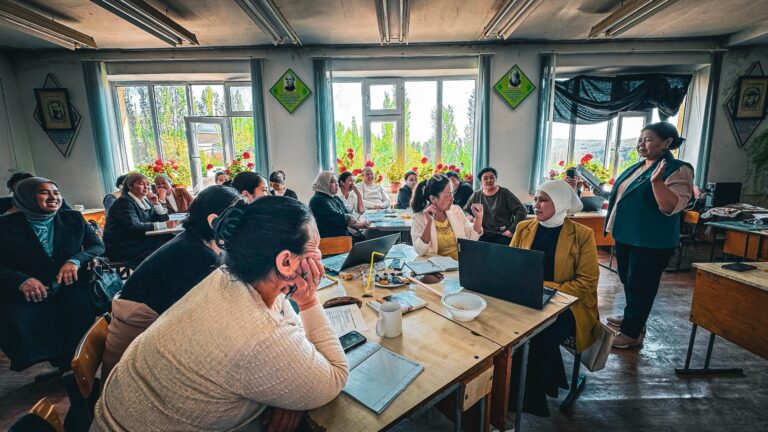
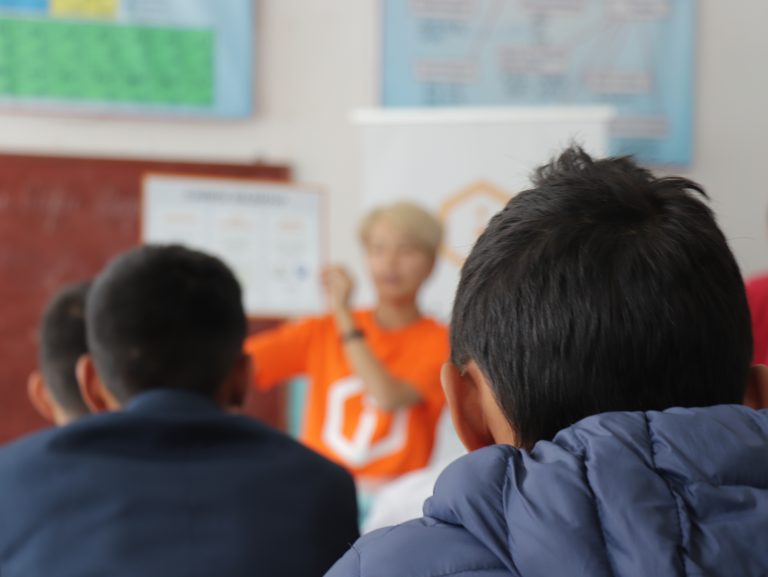
High in the mountainous terrain of Leylek district, the village of Chimgen became an unlikely epicenter of educational innovation on April 24, 2025. At the School named after Japarov, rural educators from across one of Batken Oblast’s most remote districts gathered for the culminating session of a three-day regional STEAM training initiative that had already energized teachers in Osh Oblast and the urban centers of Kadamzhay.

This final training session carried special significance, representing the program’s commitment to ensuring that geographical isolation never translates to educational isolation. The teachers who made the journey to Chimgen village embody the dedication that characterizes rural education—professionals who often serve as the sole representatives of their subjects in small schools, wearing multiple hats and serving entire communities as educational leaders.

The rural context demanded a uniquely adapted approach to STEAM methodology. While their urban colleagues in Kyzyl Kiya and Batken had access to varied resources and specialist teachers, Leylek district educators often work in schools where a single teacher might cover multiple grade levels or subjects. This reality shaped the training’s focus toward versatile, adaptable strategies that could function effectively in resource-constrained environments.

Master trainer Symbat Satybaldieva, completing her three-day journey across the region alongside co-trainers Ainaz Ysmailova and Gulmira Isakova, brought to Chimgen a refined understanding of how STEAM principles could be tailored to rural realities. The cumulative experience from Osh and Kadamzhay sessions informed adaptations that made the methodology even more accessible and practical for remote schools.

The 5E learning model took on particular relevance in this setting, where teachers recognized its potential to transform limited resources into rich learning experiences. A biology teacher shared how the “Engage” phase could begin with students’ direct observations of their mountain environment, while the “Explore” phase might involve investigating local ecosystems that urban students could only read about in textbooks.

Rural educators brought unique perspectives to Growth Mindset discussions, sharing stories of students who had overcome significant challenges to pursue education despite economic and geographical barriers. These real-world examples of resilience and determination provided powerful illustrations of neuroplasticity principles, demonstrating how belief in student potential can literally reshape neural pathways and academic outcomes.

The session’s emphasis on locally-sourced materials resonated deeply with participants who have long practiced the art of educational innovation born from necessity. Teachers shared creative solutions they had developed—using mountain stones for mathematics manipulatives, incorporating traditional crafts into engineering challenges, and utilizing agricultural cycles to teach scientific method. The training validated these approaches while providing theoretical frameworks that elevated intuitive practices to evidence-based methodologies.

PISA-aligned assessment strategies sparked particularly engaging discussions as teachers grappled with preparing students for global standards while honoring local knowledge systems. The session explored how traditional Kyrgyz problem-solving approaches could be integrated with international assessment frameworks, creating learning experiences that were both culturally grounded and globally relevant.

Artificial intelligence tools presented both opportunities and challenges in this rural context. While internet connectivity and technology access remain variable in remote areas, teachers learned to view AI as a planning and preparation tool that could enhance their instructional design even when classroom implementation might rely on more traditional methods.

The “Marshmallow Challenge” took on special meaning in Chimgen, where teachers recognized parallels to community problem-solving traditions. The activity’s emphasis on iteration, collaboration, and learning from failure mirrored approaches that rural communities have long used to address resource limitations and environmental challenges.

One of the day’s most powerful moments came during the “Food Print Puzzles” activity, when teachers connected observation and inference skills to traditional ecological knowledge that their students possess. A geography teacher noted: “My students can predict weather patterns by reading cloud formations and animal behaviors—this is scientific observation at its most sophisticated. Now I understand how to build on this foundation.”

The collaborative atmosphere was enhanced by the intimate setting, where teachers from scattered mountain schools had rare opportunities to connect with colleagues facing similar challenges. Professional isolation, a common experience in rural education, gave way to animated discussions about shared solutions and mutual support strategies.

Demo lesson presentations showcased remarkable creativity in adapting content to local contexts. A history teacher demonstrated how the 5E model could transform lessons about ancient Silk Road trade routes by having students physically map pathways through their own mountain passes, while a mathematics teacher showed how geometric principles could be explored through traditional yurt construction techniques.

The training’s rural focus highlighted the critical role that individual teachers play in their communities. Unlike urban settings where educational responsibilities are distributed among many professionals, rural teachers often serve as their schools’ primary innovators, technology coordinators, and community liaisons. The STEAM methodologies provided frameworks for managing these multiple roles more effectively.

Feedback from participants emphasized the training’s relevance to their daily realities. One teacher reflected: “Living in the mountains teaches you to be resourceful, but this training showed me how to be resourceful with purpose. Every stone, every plant, every traditional practice can become a pathway to scientific understanding.”

The Chimgen session completed a comprehensive regional initiative that demonstrated how innovative educational approaches can be successfully adapted across diverse contexts—from urban pilot schools in Osh Oblast to the busy cities of Kadamzhay region to the remote villages of Leylek district. Each setting contributed unique insights that enriched the overall understanding of STEAM implementation in Central Asian contexts.

As the three-day program concluded, the mountain setting provided a fitting metaphor for the journey these educators have undertaken. Like climbers who support each other in reaching new heights, these teachers have formed professional networks that transcend geographical boundaries, united by shared commitment to educational excellence regardless of their schools’ remote locations.

The success in Chimgen proves that transformative education is not dependent on urban resources or technological abundance, but on the creativity, dedication, and professional growth of educators who refuse to let geographical challenges limit their students’ potential. These rural teachers return to their mountain schools equipped not just with new methodologies, but with renewed confidence that they can provide world-class educational experiences in any setting.

The ripple effects of this rural training will extend far beyond individual classrooms, as these teachers serve as educational leaders in communities where their influence shapes not just student learning, but community attitudes toward education, innovation, and possibility.

Баткен областынын Кадамжай шаарындагы мугалимдер үчүн STEAM тренингдери

In the bustling educational hub of Kadamzhay, a transformative day unfolded on April 23, 2025, as dedicated educators from three dynamic cities—Kyzyl Kiya, Bujum, and Batken—converged at School #17 named after Masalieva for an intensive STEAM training experience. This gathering represented the second phase of a comprehensive regional initiative that had begun in Osh Oblast the previous day, extending innovative pedagogical approaches across southern Kyrgyzstan’s educational landscape.
The single-day intensive format demanded a focused approach, concentrating the most impactful elements of STEAM methodology into actionable strategies that teachers could immediately implement. Unlike traditional professional development sessions, this training emphasized hands-on experimentation and peer collaboration, recognizing that educators from these three cities bring diverse perspectives shaped by their unique urban and semi-urban contexts.

Master trainer Symbat Satybaldieva, supported by co-trainers Ainaz Ysmailova and Gulmira Isakova, adapted the comprehensive STEAM curriculum to address the specific challenges faced by teachers working in resource-diverse environments. The educators gathered represented a cross-section of subjects and grade levels, united by their commitment to elevating student engagement and learning outcomes through scientific inquiry and integrated approaches.

The heart of the Kadamzhay session centered on the practical application of the 5E learning model—Engage, Explore, Explain, Elaborate, and Evaluate. Teachers worked in mixed-city groups, designing mini-lessons that transformed traditional content delivery into dynamic, student-centered experiences. The collaborative nature of these activities created natural opportunities for educators from different cities to share local innovations and adapt successful practices to their own contexts.

One particularly powerful moment emerged when a mathematics teacher from Kyzyl Kiya demonstrated how geometric concepts could be explored through architectural elements found in their city’s Soviet-era buildings, while a colleague from Batken showed how similar principles applied to traditional Kyrgyz construction techniques. This cross-pollination of ideas exemplified the program’s goal of making abstract concepts tangible through local relevance.

The training’s emphasis on Growth Mindset resonated strongly with participants who often face the challenge of motivating students in economically challenging environments. Teachers engaged with research on neuroplasticity, discovering how understanding the brain’s capacity for change could revolutionize their approach to student potential. This scientific foundation provided educators with evidence-based strategies for encouraging persistence and resilience in their classrooms.

PISA-aligned assessment strategies took on particular significance in this setting, as teachers grappled with preparing students for international standards while maintaining connection to local contexts. The session included practical workshops on developing critical thinking tasks that mirror global assessments while incorporating culturally relevant scenarios that students could relate to and engage with meaningfully.

The integration of artificial intelligence tools sparked considerable discussion among participants, many of whom had limited previous exposure to educational technology. Rather than viewing AI as a replacement for traditional teaching methods, educators learned to conceptualize these tools as collaborative partners that could enhance their ability to personalize instruction and provide immediate feedback to students.

Interactive demonstrations brought theoretical concepts to life through engaging activities. The “Marshmallow Challenge” revealed insights about teamwork, iteration, and learning from failure, while “Food Print Puzzles” developed observation and inference skills crucial for scientific thinking. These activities served dual purposes: modeling effective STEAM pedagogies while providing ready-to-use classroom activities.

Teachers from Bujum particularly appreciated the emphasis on resource optimization, learning how everyday materials could be transformed into powerful learning tools. The session included practical demonstrations of creating laboratory equipment from locally available materials, addressing a common challenge in schools where traditional science resources may be limited.

The collaborative atmosphere extended beyond formal sessions, with educators naturally forming professional networks that crossed city boundaries. Teachers exchanged contact information and began planning follow-up collaborations, recognizing that the challenges they face are often similar despite geographical differences.

Feedback from participants highlighted the value of the intensive format, with many noting that the concentrated learning experience created a sense of urgency and focus that enhanced retention and application. One educator commented: “This single day changed how I think about every lesson I teach. The 5E model isn’t just for science—it’s a way of thinking about all learning.”

The training’s success in Kadamzhay demonstrates the scalability of innovative educational approaches across diverse contexts. By bringing together educators from three different cities, the program created opportunities for knowledge sharing that extended far beyond the formal training hours. Teachers returned to their schools not just with new methodologies, but with expanded professional networks and renewed enthusiasm for educational innovation.

This Kadamzhay experience represents a crucial link in the broader regional transformation of education, connecting the pilot innovations tested in Osh Oblast with the rural implementations planned for Leylek district. The urban and semi-urban perspectives contributed by Kyzyl Kiya, Bujum, and Batken educators provide valuable insights for adapting STEAM approaches across the diverse educational landscape of southern Kyrgyzstan.

As these educators return to their classrooms, they carry with them not just new teaching strategies, but a shared vision of educational excellence that transcends city boundaries. The collaborative spirit fostered during this intensive day continues to ripple through professional conversations and classroom innovations, creating a sustainable foundation for long-term educational transformation in the region.

The success of the Kadamzhay training reinforces the importance of bringing high-quality professional development directly to educators in their regional contexts, recognizing that transformative change happens when teachers have immediate opportunities to collaborate, experiment, and implement new approaches within their familiar professional communities.

Айылдык мектептердин интернетке туташуу мониторингинин алгачкы жыйынтыктары

The initial monitoring of the school connectivity demonstrated lack of the promised speed by Internet Service Provider. The internal wired and wireless infrastructure were the other issue of low connectivity leaving teachers and schools an opportunity to benefit from Internet provided by authorities.

Methodology

To assess the technical condition of the Internet infrastructure of 10 pilot schools in the Osh and Batken regions of the Kyrgyz Republic, the following activities were carried out:

  • Video interviews with school principals and IT teachers were conducted in Kyrgyz to identify current challenges and needs of educational institutions.
  • Remote diagnostics of the condition of equipment, communication lines and current Internet connection speed.
  • Analysis of building plans to study the location of classes, network nod locations and used network equipment.
  • Collection of data on internet service providers and tariff plans, as well as technical network parameters.

Based on our previous research we learned that all networking and information technology issues delegated as additional responsibility to teachers of the informatics, computer science classes. Therefore, the teachers were important source of information providing preliminary insights about the state of connectivity.

The remote diagnostics had been conducting using video call and overview of the cabling to the schools, media converters, routers and switches as well as end devices such as computers, laptops, etc.

We have used different testing platforms to monitor school connectivity including such parameters as speed diagnostics, browsing, Quality of Service, latency rate to key data centers and internet exchange points, as well as compliance of existing infra to LAN cabling engineering standards. Some parameters were tested using such diagnostics services as Ookla Speedtest, fast.com focused on quality of streaming services, and nPerf that rely upon the mLab measurement protocol (NDT7). Note that the GIGA Daily Check Up App was not available to Kyrgyzstan therefore ignored in testing stage.

The buliding information modeling helped us to understand the quality of wireless signal, possibility of wireless mesh network across the school, existing capacity, needs and challenges for schools to be fully connected and enjoy the seamless digital education experience.

Findings

  • All of the secondary schools had low-bandwidth capacity routers from two vendors with a maximum speed of up to 300 Mbps, limited processor performance and memory capacity suitable for home or small office usage only. The routers haven’t been able to cope with all connections.
  • Pilot schools were utilizing combined internal connectivity infrastructure – LAN cable connecting computer classrooms and wifi connection for teachers. The actual internet speed ranged between 340Kbps to 16Mbps.
  • Based on the Cabinet of Ministry’s decision KyrgyzTelecom Joint Stock Company had been selected as the single supplier of the internet services for all 2200 secondary schools of Kyrgyzstan. The terms of the agreement were classified and not available publicly. According to the interview, the Ministry of Education paid roughly 2500 Kyrgyz soms monthly fee per school in duration from September to June, while summertime were unpaid.

Photo gallery of school connectivity monitoring results

The problem of digital inequality during a pandemic

Chairman of the Kyrgyz Internet Society (ISOC) Talant Sultanov told how the pandemic affected digitalization in Kyrgyzstan during the round table: “The pandemic of digitalization. How the coronavirus has affected business”
The pandemic tested the EAEU countries in difficult conditions to what extent they were ready to respond to challenges, including digital ones. Kyrgyzstan, it seemed to me, was better prepared than it could have been expected. This happened because the digital agenda has been a priority for the country for several years.

The topic itself began to develop in 2017-2018 with the program “Taza koom” (clean society) and transformed into the program “Digital Kyrgyzstan”. The negative effects of the pandemic were felt by both states and businesses. However, the activation of digital technologies in parallel has opened up three possibilities for reducing digital inequality: the possibility of access, use, and maintenance. How were they used in the Kyrgyz Republic?

The first initial one is the possibility of access. Although many people had to go into quarantine, not all remote work was set up, access to the network was configured. Even if there was an Internet connection, there was no way to access devices – computers, smartphones.

Moreover, civil servants who went to remote work could not fully function, and therefore they still came to their workplaces to put signatures on paper. There are few positive effects here.

The second possibility is the possibility of convenient use. Even if users have the Internet, there is a device at home through which they can access the Internet, then how convenient were the services and applications that were developed during the pandemic? An interesting aspect is how usability has allowed the government to become closer to citizens. We now have senior officials conducting surveys via social networks about what policies to pursue or not to pursue. This is an indicator of how flat the government is becoming, the hierarchy is disappearing.

The third possibility is the possibility of maintaining and continuing all these initiatives. When the pandemic began, many online services were launched. However, if we try to check their relevance today, many sites have simply stopped functioning. All these three possibilities so far only show how digital inequality is becoming even wider and deeper. And in order to reduce this digital gap, it is necessary to take urgent measures. Here, the private sector and business in general in the country play an important role. But business stops where there is no profitability, profit. Then the state picks up, but the state also has a certain budget, beyond which it cannot go. At the moment, the government is implementing the Digital Central Asia – South Asia project, which plans to connect every locality in the country to broadband high-speed Internet.

Then the local population, and in particular, the Internet community should pick up the idea. I will focus on the things that our online community does in order to address the designated opportunities. We are currently implementing a project called Ilim Box. Let me remind you that earlier the Ministry of Education of the Kyrgyz Republic took measures to provide all schools of the Republic with network access. The department was able to organize the connection of all schools, except twenty, which are located in the most remote, mountainous areas of the country.

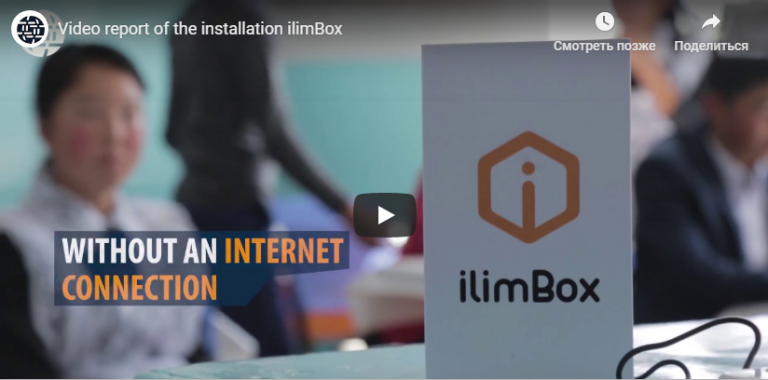
We regard this as a challenge for our community, and before a full-fledged Internet is held, we decided to come to these children with a “box of knowledge”. Such a device allows you to access all educational resources without an Internet connection. Children and schoolchildren will be able to use educational content without going online, because somewhere in the country there are still no funds to access the network.

As for usability, at the second stage of the project, we are already developing Ilim Box 2.0. This is an educational portal where all the necessary data on the field, now relevant in the Kyrgyz Republic, were collected. We did it in a more friendly format than it usually happens with educational platforms, because it is difficult to keep children’s attention when there is competition with YouTube and entertainment portals.

Therefore, educational digital resources should be interactive and accessible to young children. However, digitalization as a whole brings various challenges that we must address both at the country level and at the level of the Eurasian Economic Community. The first challenge associated with digitalization is the protection of personal data. During the first wave of the pandemic, there were several cases when private data of citizens fell into open access.

The second aspect is the legal field. In our country, the implementation of many things could be facilitated if the right laws and regulations were developed. For example, local residents of remote areas can collect resources, money, and specialists can provide people with knowledge. However, they still need to get various licenses, access to radio frequencies, which is almost impossible for a rural resident.

If the government facilitates these conditions, then digitalization in its general sense for residents of the most remote regions will be much faster, easier and cheaper. Another aspect is the sharing of infrastructure. When a new road is being laid, it may be excavated again in a few weeks or months to lay some kind of pipe. In this regard, it would be possible to develop rules for the use of infrastructure. If a road is being built, an Internet cable and other communication should be laid there at the same time – this will facilitate the work, shorten the time.

The third challenge is digital skills. The goal of digitalization is to connect the very last mile, the most final user. In addition to connectivity, it is important to help the residents of the countries get digital skills so that users can work effectively on the network.

The event was held within the framework of the international information and educational project “Eurasian Bridge”.

Bringing digital education to remote village schools with Ilimbox

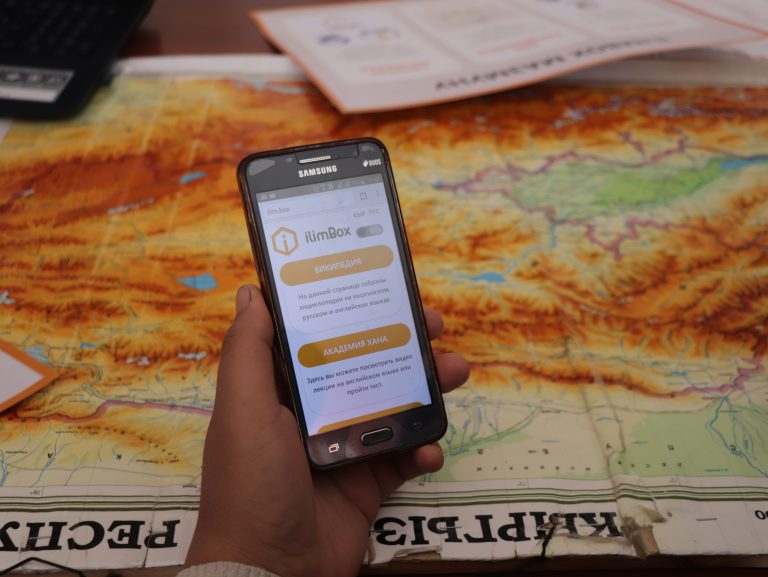
Ilimbox-digital source of knowledge-a product implemented on the basis of Orange Pi in order to provide access to students and teachers of remote secondary schools of the Kyrgyz Republic to textbooks in digital format, Wikipedia and resources of Khan Academy in offline mode.
The Ilimbox project is funded by the Beyond The Net program created by the Internet Society Foundation and AIEF2018. The project is implemented by the Kyrgyz Chapter of the Internet Society ISOC.

About ilimBox and other projects ISOC.KG, you can follow the links:

https://isoc.kg/ilimbox/

https://www.facebook.com/isockg/

Installation of devices of ilimBox in Talas district, Talas region

17 Sep 2019 team ISOC went to Talas to install ilimBox devices in schools. The first 5 (five) secondary schools were selected in Talas district: school of Tuitunova (Taldy-Bulak), school of R. Aydaraliev (Kopuro Bazar), school of A. Borubaev (Kara-Oh), school of  Zhumagul Alymkul (Sasyk-Bulak), school of G. Orozalieva (Kenesh).

Talas district is an administrative unit that occupies the East of Talas region, the administrative center is the village of Manas. This district was the largest in length in comparison with other districts of Talas region.

According to the reports of the Ministry of education and science, schools in Talas region are 100% covered by the global Internet, but on the ground, we saw a different picture. Despite the fact that there live active users who quickly respond to the new technical capabilities of mobile Internet, however, in all five schools of Talas district, it was revealed that children do not have access to the General Internet of the school. Moreover, in two schools of this area, in an office of administration use the mobile Internet, respectively, teachers are also compelled to prepare for occupations on books in library which as they admitted, catastrophically isn’t enough to children that are compelled to give one book on two and all academic year children divide it “in half”. Thus, there are three main reasons for choosing these schools: students do not have access to the Internet, there is a shortage of books and the number of students exceeds the permissible maximum.

The above situation motivated us to go there to present an interesting alternative to the Internet as a device – ilimBox. The project aims to address problems such as the lack of books and the lack of Internet in General education institutions. In these schools, it was conducted presentation of the project “ilimBox” and testing the device with students and teachers.

We explained that the digital library contains a Wikipedia in Kyrgyz, Russian and English, Khan Academy in English, thousands of video and audio lessons and e-books. The guys were surprised that the device allows you to access all educational resources without an Internet connection. The school administration gladly and gratefully accepted our gift, and left video reviews that are uploaded to the youtube channel ISOC.


Kyrgyzstan has developed a useful alternative to the Internet for schoolchildren

In recent years, the Internet has become increasingly accessible to Kyrgyz people. If about 5 years ago only residents of the capital could afford access to the world wide web, now it is quite a familiar thing for residents of the regions.
The Internet plays an important role in modern education. Problems such as the shortage of school textbooks could be addressed through quality Internet access. Given this fact, the Ministry of education of Kyrgyzstan has carried out a lot of work in this direction and for 2 years connected almost 2 thousand state and municipal schools to the Internet, which is almost 90% of all schools in the country. However, the analysis showed that schoolchildren still do not have access to the world wide web. Fearing that students will be distracted from lessons and use the Internet for other purposes, school authorities do not provide students with access.

Innovative solutions to two pressing problems such as the lack of books and the lack of Internet can be seen in the project digital library for schools and public libraries “Ilim Box”, which contains Wikipedia in Kyrgyz, Russian and English, Khan Academy in English, thousands of video lessons, audio and e-books. All these digital learning materials are available offline, in other words does not need Internet access. Access to Digital libraries will be carried out through smartphones, tablets, computers and any other personal devices with Wi-Fi technology.

“As you know, the Internet has a huge number of educational resources that would help our children to access the most advanced knowledge online. Unfortunately, now a lot of students can not watch educational videos, read online books and use all educational resources. In order to solve this problem, we launched a project Ilimbox”, – said the representative of the Internet community in Kyrgyzstan (ISOC) Talant Sultanov.
The device allows you to access all educational resources without an Internet connection, in other words offline.
“The content that is online, we downloaded to the hard drive, attached a small computer that also acts as a Wi-Fi router. Any user will be able to download the necessary information to your computer or smartphone. What is most important-the user gets access only to educational resources, he will not have access to social networks and other entertainment content”, – explained Talant Sultanov.
It is worth noting that all data is stored in the device itself, and only the power supply and the box itself are needed for connection. The uniqueness of the innovative project is that students can access educational resources at school without an Internet connection.
“This is a very useful device, because on the one hand it provides access to an extensive database of educational materials, and on the other – it does not have entertainment content that would interfere with students during lessons. We are very happy that we had the opportunity to IlimBox and use it for educational purposes”, – shared his impressions the Director of one of schools of Karakol Gulzat Soukouna.

It should be noted that the IlimBox device was installed in 66 schools of Issyk-Kul, Talas and Chui regions. In these schools was held a presentation of the project “Ilim box” then testing the device with students and teachers and handing the device. During the conversation, the importance of education and self-education were touched upon. The choice of schools was due to several factors: no access to the Internet for students, lack of books, as well as the number of students exceeded the permissible maximum, thereby increasing the likelihood of poor performance in schools without a network connection, as well as the choice of educational institutions influenced the list of proposed schools by the Ministry of education and science of the Kyrgyz REPUBLIC.
The project is planned to cover all regions of Kyrgyzstan and install IlimBox in a total of 100 devices in schools experiencing problems with Internet access. Every educational institution reggenie gets IlimBox free.

The project is funded by Alumni Engagement Innovation Fund 2018 (AEIF) as part of innovative solutions to global challenges and the Beyond the Net ISOC program.

A video about the project can be found here:

Russian language

Kyrgyz language

School of D. Turabekova (Boz-Bulun v., Issyk-Kul region)

The final trip was school  of D. Turabekova (Boz-Bulun v.). There are 214 students enrolled.

In this school the device “Ilim Box” was earlier established, however, it was the outdated version which as it became clear, unfortunately, wasn’t used on purpose, and gathered dust in one of offices as the head teacher lost the password from the old device.
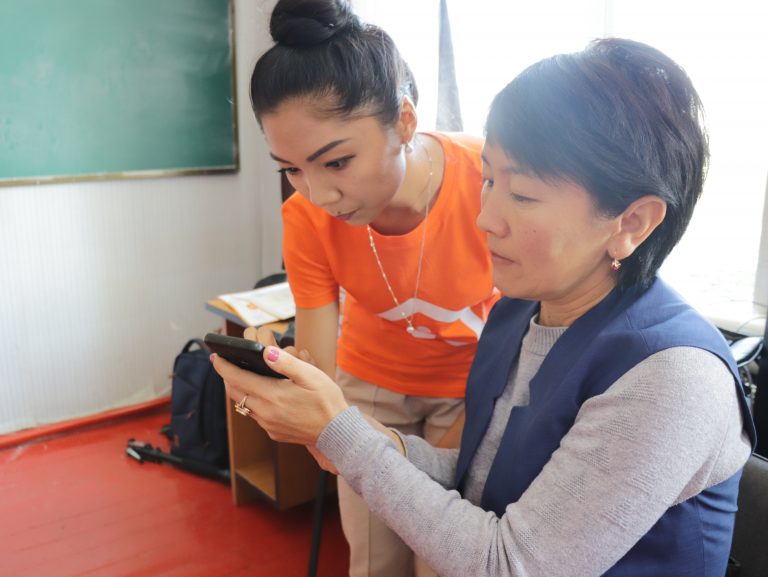
The updated version without a password system pleased the school administration.

During the presentation, we showed the improved nuances of the device and instructed on the use of high school children.


School of Eshimbekova (Tegizchil v., Issyk-Kul region)

The penultimate visit was to the school Esimbekova (Tegizchil v.).

It is a compact school with 238 children.  It is located on the outskirts of the village Tegizchil, however, despite this, at school we met a volunteer from the United States who came on a Peace Corps knowledge-sharing project.

He teaches children English for the second academic year and speaks Kyrgyz perfectly.

Teachers and children admitted, in school except an office of administration there is no Internet access anywhere.

Of course such a gift to the school was very useful and also solved the problem of acute shortage of books.

The guys offered to install the device in the office of the school government, as it is usually open around the clock.