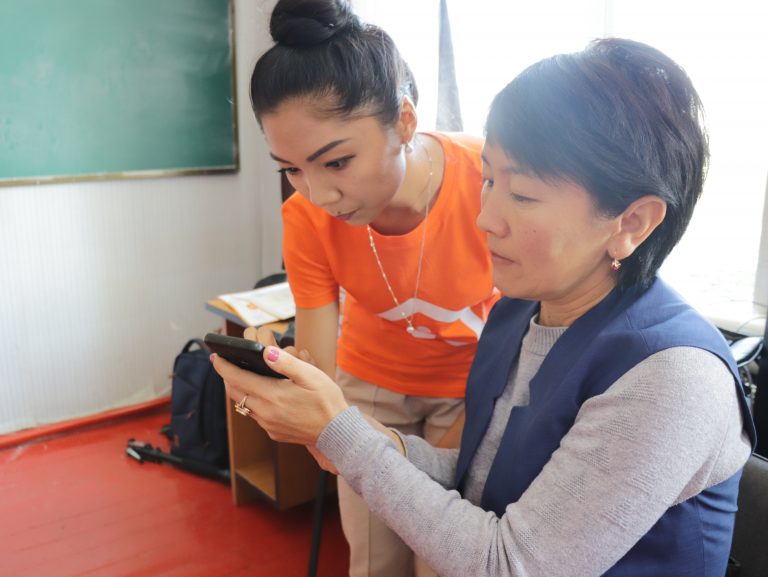
Kyrgyzstan has developed a useful alternative to the Internet for schoolchildren

In recent years, the Internet has become increasingly accessible to Kyrgyz people. If about 5 years ago only residents of the capital could afford access to the world wide web, now it is quite a familiar thing for residents of the regions.

The Internet plays an important role in modern education. Problems such as the shortage of school textbooks could be addressed through quality Internet access. Given this fact, the Ministry of education of Kyrgyzstan has carried out a lot of work in this direction and for 2 years connected almost 2 thousand state and municipal schools to the Internet, which is almost 90% of all schools in the country. However, the analysis showed that schoolchildren still do not have access to the world wide web. Fearing that students will be distracted from lessons and use the Internet for other purposes, school authorities do not provide students with access.

Innovative solutions to two pressing problems such as the lack of books and the lack of Internet can be seen in the project digital library for schools and public libraries “Ilim Box”, which contains Wikipedia in Kyrgyz, Russian and English, Khan Academy in English, thousands of video lessons, audio and e-books. All these digital learning materials are available offline, in other words does not need Internet access. Access to Digital libraries will be carried out through smartphones, tablets, computers and any other personal devices with Wi-Fi technology.

“As you know, the Internet has a huge number of educational resources that would help our children to access the most advanced knowledge online. Unfortunately, now a lot of students can not watch educational videos, read online books and use all educational resources. In order to solve this problem, we launched a project Ilimbox”, – said the representative of the Internet community in Kyrgyzstan (ISOC) Talant Sultanov.
The device allows you to access all educational resources without an Internet connection, in other words offline.
“The content that is online, we downloaded to the hard drive, attached a small computer that also acts as a Wi-Fi router. Any user will be able to download the necessary information to your computer or smartphone. What is most important-the user gets access only to educational resources, he will not have access to social networks and other entertainment content”, – explained Talant Sultanov.
It is worth noting that all data is stored in the device itself, and only the power supply and the box itself are needed for connection. The uniqueness of the innovative project is that students can access educational resources at school without an Internet connection.
“This is a very useful device, because on the one hand it provides access to an extensive database of educational materials, and on the other – it does not have entertainment content that would interfere with students during lessons. We are very happy that we had the opportunity to IlimBox and use it for educational purposes”, – shared his impressions the Director of one of schools of Karakol Gulzat Soukouna.

It should be noted that the IlimBox device was installed in 66 schools of Issyk-Kul, Talas and Chui regions. In these schools was held a presentation of the project “Ilim box” then testing the device with students and teachers and handing the device. During the conversation, the importance of education and self-education were touched upon. The choice of schools was due to several factors: no access to the Internet for students, lack of books, as well as the number of students exceeded the permissible maximum, thereby increasing the likelihood of poor performance in schools without a network connection, as well as the choice of educational institutions influenced the list of proposed schools by the Ministry of education and science of the Kyrgyz REPUBLIC.
The project is planned to cover all regions of Kyrgyzstan and install IlimBox in a total of 100 devices in schools experiencing problems with Internet access. Every educational institution reggenie gets IlimBox free.

The project is funded by Alumni Engagement Innovation Fund 2018 (AEIF) as part of innovative solutions to global challenges and the Beyond the Net ISOC program.

A video about the project can be found here:

Russian language

Kyrgyz language

School of Eshimbekova (Tegizchil v., Issyk-Kul region)

The penultimate visit was to the school Esimbekova (Tegizchil v.).

It is a compact school with 238 children.  It is located on the outskirts of the village Tegizchil, however, despite this, at school we met a volunteer from the United States who came on a Peace Corps knowledge-sharing project.
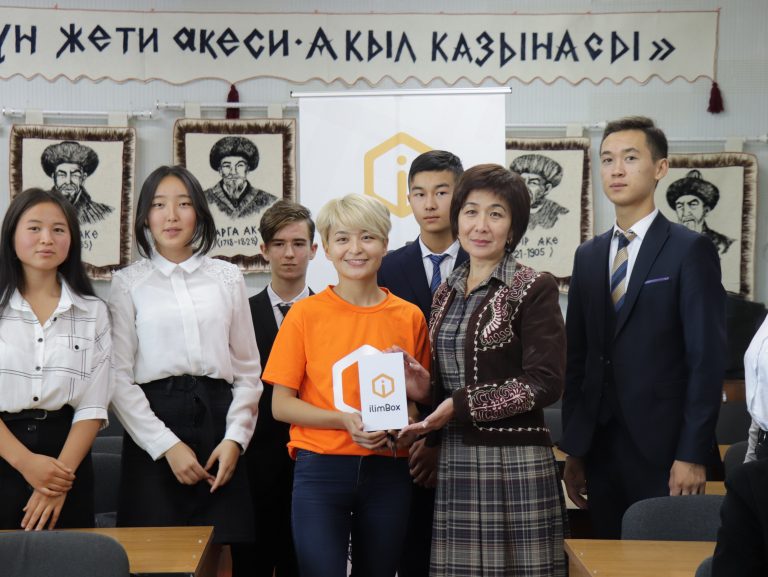
He teaches children English for the second academic year and speaks Kyrgyz perfectly.

Teachers and children admitted, in school except an office of administration there is no Internet access anywhere.

Of course such a gift to the school was very useful and also solved the problem of acute shortage of books.

The guys offered to install the device in the office of the school government, as it is usually open around the clock.

School gymnasium №11 (Karakol, Issyk-Kul region)

In Karakol we visited the gymnasium school №11.

This is one of the largest educational institutions of Issyk-Kul region, in which we have established ilimBox, it has 2600 students, children study in double shifts school.
Despite the fact that the school is a gymnasium and is located in Karakol, it still has difficulties accessing the global network.

As high school students admitted, they liked the project with free access to educational information and the opportunity to learn English through the educational resource “Khan Academy”.

The device was installed in the office of computer science and attached instructions for use in Russian.

Ferghana Valley IXP

ISOC Kyrgyz Chapter is implementing one of its first major projects thanks to Beyond the Net grant from ISOC. Ferghana Valley Internet Exchange Point (FVIXP) Project will install an IXP in Osh city in the south of Kyrgyzstan, which will result in a much cheaper internet for all the residents of Ferghana Valley.

Ferghana Valley located on crossroads of three countries is the most populated area in Central Asia, the source of regional inter-ethnic tensions due to water and land irrigation disputes, poverty and lack of access to communication services. Internet Exchange Point Project with location in Osh city (Kyrgyzstan) is aimed to increase regional cross-border collaboration between stakeholders and communication of people through increase of Internet affordability by lowering internet tariff plans up to 3 times, multiply growth of Internet traffic exchange in region, increase Internet penetration rate due to price reduction, and improve latency for international and regional content sources.

Ferghana Valley located at the crossroads of three countries of Central Asia: Kyrgyzstan, Uzbekistan, and Tajikistan are in top 10 regions with highest population density in the world. Over 14 million people (2014) reside in 22,000 square kilometers (approximately 636 persons per square km). The region is known for land and water disputes, inter-ethnic conflicts. There is a huge income disparity between administrative capitals of the Stans and regional dwelling communities in Ferghana Valley.

Central Asia has one of the lowest internet penetration rates per capita in Europe and Central Asian region, according to ITU 2014. One of the key regions that illustrate state of the regional digital divide is Ferghana Valley. In regional perspective Internet prices for Ferghana valley dwellers are higher than for residents of other administrative districts. For example, Internet tariff plans in southern cities are 5 times higher (13USD) for the same traffic bandwidth than that in Bishkek located in the North of Kyrgyzstan. Tajikistan, which primarily depends on Internet transit of Russian content from Kyrgyzstan, has an even more severe situation. National ISP Tojnet provides 1Mb unlimited tariff for as low as 45USD. The situation in Uzbekistan is even worse. Uzbekistan ISP monopoly company provides Internet in cities located in Ferghana valley for the price of 59USD for 10GB of the daily Internet and unlimited night traffic.

Considering above mentioned situation we believe establishing Internet Exchange Point in the valley will alleviate the digital divide between the north and south of Kyrgyzstan as well as between the bordering countries by removing barriers for connectivity and stimulating better access.

Internet Exchange Point is a physical location where different stakeholders who have ASN meet to exchange local traffic via a switch. Kyrgyzstan is one of the countries where Ferghana Valley is spread. There are several closed IXPs based in Bishkek (ISP, banks). Unlike present IXPs that could not be neutral and open for new members by Charter, Ferghana Valley IXP (FVIXP) will follow principles of openness and neutrality by providing equal access to infrastructure to all stakeholders, including Government agencies, educational and healthcare institutions as well as commercial banks. IXP will help local small and medium ISP to minimize traffic costs, spend more on infrastructure rather than on internet traffic purchase.

Establishing IXP would greatly enhance the utility and value of the regional Internet and promote the growth of the digital economy. According to Terabit Consulting, “Improvement in ICT infrastructure yields: Increased demand for the output of other industries (demand multiplier), New opportunities for production in other industries (supply multiplier), new goods and services for consumers (final demand). It also increases firms’ innovation capabilities and increases the probability of new products, innovations, and organizations.”


Connecting the unconnected – walking the talk in Central Asia

Access to an open and inclusive Internet has been widely discussed in the framework of the UN Sustainable Development Goals (SDGs) and the global Internet Governance Forum (IGF) over the last few months. The Internet Society’s Regional Bureaus work hard to put the good work and messages stemming from these global forums into practice in our respective regions.

Last week, the Internet Society’s European Regional Bureau (ERB) together with our local partners reached another milestone in our ongoing engagement in the Kyrgyz Republic. We launched our first report in Central Asia providing an assessment of the Internet environment in the Kyrgyz Republic during the Open Government Innovation Week in Bishkek, organized by the Kyrgyz government, the UN Development Program (UNDP) and the World Bank. The report touches on critical policy and technical issues in the context of Internet development, offering food for thought both for the government and the technical and business communities. You can read the full report in English or in Russian on our website!

Better yet, the ERB, with Tommi Karttaavi in the lead, formally launched the ISOC chapter in the Kyrgyz Republic. The newly created Kyrgyz chapter will focus on development of Internet infrastructure and content to improve national Internet adoption levels. The chapter also plans to organize open debates to discuss and popularize the Internet as a platform for social and economic progress. This is very exciting news for us, as national chapters are the foundation for a sustained ISOC engagement at the local level.

Finally, following various policy and technical discussions on the importance of a well-functioning Internet exchange point (IXP) with the local Internet community, Kurtis Lindqvist and Jane Coffin ran a two-day training workshop on IXPs and the Border Gateway Protocol (BGP). The training session was successful in many ways, but most strikingly it was the first time this group of qualified engineers from local ISPs met to discuss the peering environment and common challenges. The content and conclusions of this training will be made available on the IXP toolkit website.

So, what did we learn from this whirlwind of a week in the Kyrgyz Republic? By carrying out policy advocacy and technical capacity building in parallel we can approach the Internet connectivity challenge in a holistic way. Policy is often a long-term tool, whereas technical training can have an impact in a matter of days. Although ISOC believes in driving change through bottom-up processes, we also need to maintain dialogue with high-level decision-makers to have the right top-down messages. And finally, you cannot underestimate the value of building a community. After every event, training and discussion, our community is a little bit larger and more varied – a stronger team to connect the unconnected.

This is all part of an Internet Society philosophy for development – connectivity, community, and capacity development and the policies that sustain them. We believe strongly in this formula for development and look forward to continued engagement with our colleagues in the Kyrgyz Republic and the Central Asian region.

By Maarit Palovirta
Senior Manager, Regional Affairs Europe

Download full report