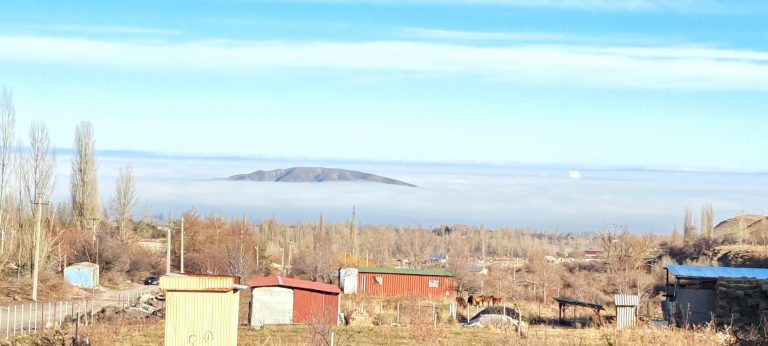
Field notes challenges on installation of gateways in mountainous areas

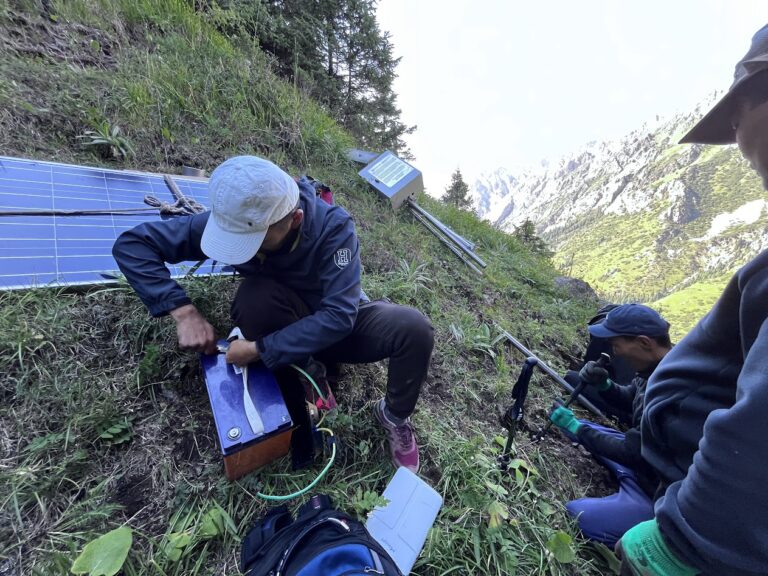
Climbing 700 meters with a 55° slope with solar panels, heavy batteries, and an IoT communication gateway strapped to our backs is not the usual picture of innovation and one wouldn’t think of AI in such context. However, this was exactly what it took to bring climate monitoring communication network to one of the most remote and high altitude places on Earth.

Recently, our team completed the installation of an IoT communication gateway near the Kara-Batkak (3360-4800 altitude) and Aylama glaciers in the Terskey-Alatoo mountain range. This system will connect affordable climate-related sensors at high altitudes — places where critical data is still missing not only in Kyrgyzstan or Third Pole, but globally.

Most foundational climate AI models today rely on assumptions to fill in gaps (cdf-mapping, bias-correction, etc), because the ground data from mountainous regions simply doesn’t exist. The cryosphere — glaciers, snow, and permafrost — remains under-observed, under-researched particularly in the world’s high mountain ranges. The Third Pole Regional Climate Center reported that in the entire Pan-Third Pole region, only 28 monitoring stations sat above 3000 meters out of nearly 700. These are exactly the altitudes where some of the most dramatic changes are taking place.

And the stakes are high. According to ICIMOD even in a world that warms by just 1.5 to 2°C, glaciers in the Third Pole could lose 30 to 50 percent of their volume by the end of this century. Without precise, high-resolution data, real-time data, AI models risk underestimating the hazards we face, from permafrost instability and glacier detachments to glacial lake outburst floods and snow droughts.

That is why Precision matters! Even down to the third-fourth decimal place, every data point helps improve forecasts, anticipate risks, and strengthen climate models that inform policy and adaptation strategies.

The summertime is high season for field works and installations far from the digital sphere in unconnected areas trying to connect the last-mile and secure supply of high precision data for scientists and local communities. For me, the climb was exhausting, but also deeply meaningful. Just like other teammates, I’ve suffered from pain, exhaustion, walking/falling through slippery meadows… Right there in altitude of 3000, looking into the downstream rivers, with spectacular views around, it was a reminder to me that innovation doesn’t only happen in labs, conference rooms, or algorithms. Sometimes it begins with sweat, altitude, and determination — carrying heavy equipment up a mountain so that the world can better understand what is at stake. And it was the second from 15 installations planned under the research project funded by the Internet Society Foundation and implemented by the Internet Society Kyrgyz Chapter along with partners.

Lorem ipsum dolor sit amet, consectetur adipiscing elit. Ut elit tellus, luctus nec ullamcorper mattis, pulvinar dapibus leo.

IoT LoRaWan in monitoring natural disasters Forum Announcement

ISOC Kyrgyz Chapter is organizing forum "Application of innovative technologies in monitoring and forecasting of climate change and natural disasters" in Bishkek

Protecting people’s lives and property from disasters related to weather, climate and water has been and remains the most important task for ensuring global sustainable development.

Most of the results presented recently by climate scientists are alarming. The mass of greenhouse gases in the atmosphere is increasing faster than originally predicted. Scientists, economists and policy makers are calling for a reduction in emissions benchmarks. A number of positive steps have been taken to prevent the most adverse scenarios of climate change. Affordable new technologies that contribute to mitigation have become available, such as the use of solar and wind energy, electric vehicles and vehicles.  Thirty-two countries have successfully reduced their emissions in the last 15 years, and their economies continue to grow.

In the prevention of natural disasters, multiple methods have been developed: observation, research, forecasting, taking into account the receipt of data from various stations. The combination of devices and services that collect, transmit and display data and information electronically leads to easier work in forecasting. This includes personal computers (PCs) and their peripherals, broadband networks and telecommunication devices, as well as data processing centers.

One of such technologies is LoRaWAN data transfer technology for the Internet of Things IoT. The principle of operation is that smart sensors monitor indicators online, analyze them and transmit data to the server. Through the application, sensor data is displayed on the monitor. In general, the system is able to independently evaluate hundreds of indicators, which allows, for example, to unload responsible employees. Unskilled routine operations can now be safely entrusted to the machine, leaving employees more time for intellectual work.

All sensors work autonomously without power supply for up to 10 years without wires. This is especially true for stations that transmit data using electricity or panels.  The absence of wires also makes the process of implementing the technology as simple and convenient as possible. At the same time, the cost remains affordable for mass use.

Internet Society Kyrgyz Chapter in partnership with Central Asian Institute for Applied Geosciences is planning to conduct presentation forum “Application of innovative technologies in monitoring and forecasting of climate change and natural disasters” with key stakeholders on use of LoRaWAN technology and internet of things to monitor and predict natural disasters in the Kyrgyz Republic. The forum will be held on December 7, 2022 in Park Hotel, Bishkek.

Agenda

Presentation Forum

“Application of innovative technologies in monitoring and forecasting of climate change and natural disasters”

Moderator: Moldobekov Bolot Duishenalievich / Talant Isakovich Sultanov

13.30-14.00

Registration of participants /coffee break

14.00-14.30

Welcome words:

Mr. Shaazadan Akylbekovich Tyumonbaev – Deputy Head of the Monitoring and Analysis Department of the Administration of the President of the Kyrgyz Republic

Mr. Mazaripov A.A. – Deputy Minister of Emergency Situations of the Kyrgyz Republic

Mr. Beksultan Melisovich Ibraimov-Ministry of Natural Resources, Ecology and Technical Supervision of the Kyrgyz Republic

Mr. Bolot Duishenalievich Moldobekov – Co-Director of CAIAG

Mr. Talant Isakovich Sultanov – Chairman and Co-Founder of the Kyrgyz Internet Society ISOC

14.30-14. 50

“Monitoring and forecasting of climate change and natural disasters”

Mr. Bolot Duishenalievich Moldobekov – Co-Director of CAIAG

14.50-15.00

Q&A – Aziz Soltobaev

15.00 -15.15

” Environmental monitoring system “

Mr. Alexander Vladimirovich Zubovich – Head of Department No. 3, CAIAG

15.15 -15.25

Q&A – Aziz Soltobaev

15.25 – 16.00

Coffee break

16.00-16.30

“Creating an open and secure infrastructure of the Internet of Things using LoRaWAN technology for monitoring and preventing emergencies in the mountainous areas of Kyrgyzstan”

Mr. Talant Isakovich Sultanov – Chairman and Co-Founder of the Internet Society Kyrgyz Chapter

16.30 -16.40

Q&A – Aziz Soltobaev

16.40-17.15

“Wireless Technologies for IoT”, “Pros and Cons of Lorawan Technology”

Mr. Ermanno Pietrosemoli – Scientist at the Abdus Salam International Center for Theoretical Physics

17.15-17.25

Q&A – Aziz Soltobaev

17.25-18.00

Summing up /Concluding words