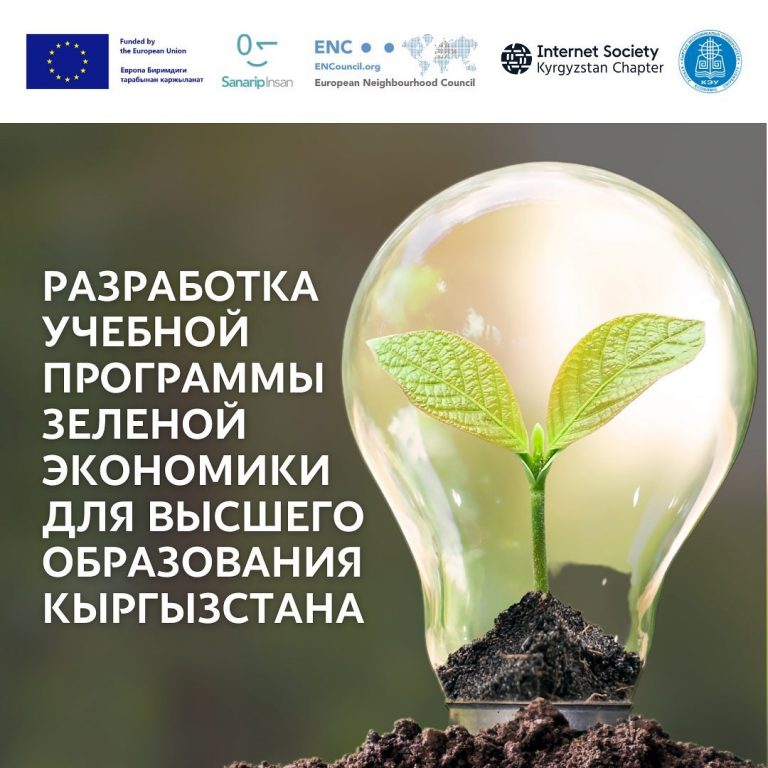
Development of a green economy curriculum for higher education in Kyrgyzstan

The project “Development of a green Economy curriculum for higher education in Kyrgyzstan”, within the framework of the Sanarip Insan project, started on November 20, 2021 and was implemented on the basis of the M. Ryskulbekov Kyrgyz University of Economics.

The project team has developed an educational and methodological complex of continuous learning based on the Lifelong learning model “Fundamentals of green Economy”, which includes 5 modules on the topics: “Green Economy”, “Environmental Law”, “Circular Economy”, “Waste Management”, “Sustainable Marketing”. Based on these lectures, 20 video lectures were filmed. The existing economic curriculum around the world with an accessible innovative green economy and the practice of education in the field of sustainable development, the choice and implementation of appropriate methods for the development of the green economy were investigated.

This program has been implemented and tested at the economic faculties of the M. Ryskulbekov Kyrgyz University of Economics, which is responsible for the development and implementation of economic education in the country. Within the framework of the project, 30 teachers, 394 students were trained in this course.
At the end of the developed UMK, 1 two-day training was held on the ZOOM platform for teachers and students, 42 teachers and 40 students from 6 universities of Kyrgyzstan and Kazakhstan took part in the training. The developed complex has been integrated into the students’ learning process as a modular course, and will also be used as lifelong learning channels using new digital capabilities.

The developed course is posted on the website http://greeneconomy.su/detail/6 and it is freely available to everyone, a video recording of all sections of the textbook was also made in the form of 20 video lectures, which will also be posted on the IlimBox platform and Youtube channel.

The main types of Internet users

The modern virtual network is a real social world in which hundreds of thousands of people communicate, meet, argue and coordinate with each other every day. And all these people have different goals, principles and views on life, which allowed them to be divided into six main categories of Internet users.
Scroll to the left to find out the user category

What category of Internet users do you belong to?

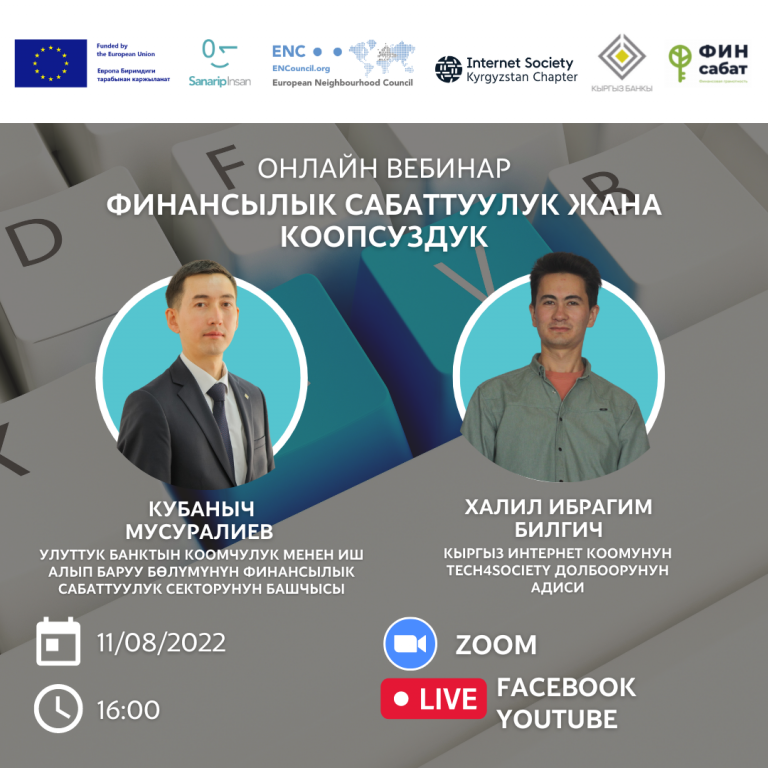
Online webinar: “Financial literacy and security”

Date: August 11
Time: 16:00
Join Zoom at the following link:
https://us06web.zoom.us/j/86241711646?pwd=UURoa1VKNHAvTm55WlBBZE5rZnFKdz09
Live stream:
Youtube: https://youtu.be/N8o1g6qbxcE
Facebook: https://fb.me/e/3GBK3AYCX

Financial literacy is a sufficient level of knowledge and skills in the field of finance, which allows you to correctly assess the situation on the market and make reasonable decisions.
Knowledge of key financial concepts and the ability to use them in practice enables a person to competently manage their money. That is, keep track of income and expenses, avoid excessive debt, plan a personal budget, create savings. As well as navigate the complex products offered by financial institutions and purchase them on the basis of a conscious choice. Finally, use savings and insurance instruments.
Poor financial literacy and lack of understanding in the area of ​​personal finance can lead not only to bankruptcy, but also to illiterate retirement planning, vulnerability to financial fraud, excessive debt, and social problems, including depression and other personal problems.
We will talk about financial literacy and security at the webinar.

The experts will be:

  • Musuraliev Kubanich Iratbekovich – head of the financial literacy sector of the Public Relations Department of the National Bank. He will tell you about financial literacy and the finsabat.kg project of the National Bank of the Kyrgyz Republic.
  • Khalil Ibragim Bilgich is a specialist of the Tech4Society project of the Kyrgyz Internet Society. He will give you advice on how to use bank cards, e-wallets, online banking applications correctly and safely.

World Day against Human Trafficking

July 30 is the World Day against Human Trafficking. Human trafficking is a serious crime and a serious violation of human rights.

Every year thousands of men, women and children fall into the hands of traffickers both at home and abroad. All countries of the world, whether a country of origin or a transit country, suffer from human trafficking. Traffickers have become adept at using internet platforms, including social networks, online stores and other web pages, to attract victims and attract customers.

Today it is important to have digital skills to protect yourself and your loved ones from human trafficking.