Полевые заметки о вызовах при установке шлюзов в горных районах

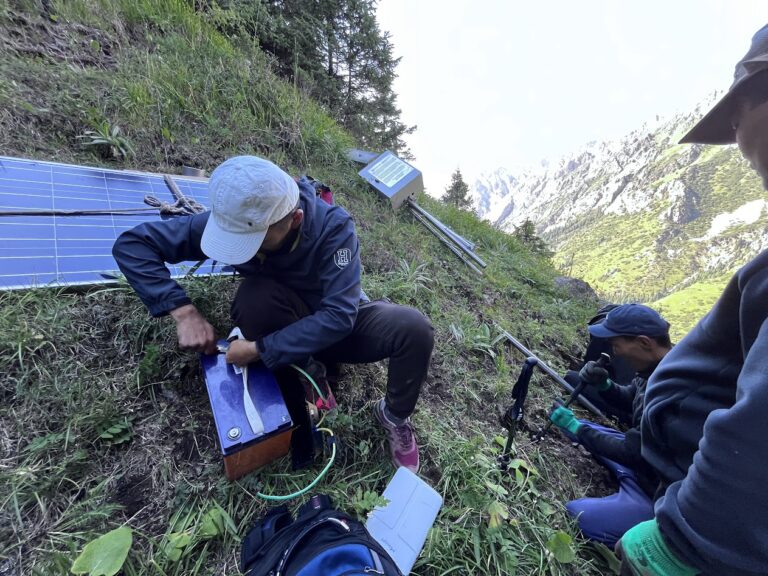
Climbing 700 meters with a 55° slope with solar panels, heavy batteries, and an IoT communication gateway strapped to our backs is not the usual picture of innovation and one wouldn’t think of AI in such context. However, this was exactly what it took to bring climate monitoring communication network to one of the most remote and high altitude places on Earth.

Recently, our team completed the installation of an IoT communication gateway near the Kara-Batkak (3360-4800 altitude) and Aylama glaciers in the Terskey-Alatoo mountain range. This system will connect affordable climate-related sensors at high altitudes — places where critical data is still missing not only in Kyrgyzstan or Third Pole, but globally.

Most foundational climate AI models today rely on assumptions to fill in gaps (cdf-mapping, bias-correction, etc), because the ground data from mountainous regions simply doesn’t exist. The cryosphere — glaciers, snow, and permafrost — remains under-observed, under-researched particularly in the world’s high mountain ranges. The Third Pole Regional Climate Center reported that in the entire Pan-Third Pole region, only 28 monitoring stations sat above 3000 meters out of nearly 700. These are exactly the altitudes where some of the most dramatic changes are taking place.

And the stakes are high. According to ICIMOD even in a world that warms by just 1.5 to 2°C, glaciers in the Third Pole could lose 30 to 50 percent of their volume by the end of this century. Without precise, high-resolution data, real-time data, AI models risk underestimating the hazards we face, from permafrost instability and glacier detachments to glacial lake outburst floods and snow droughts.

That is why Precision matters! Even down to the third-fourth decimal place, every data point helps improve forecasts, anticipate risks, and strengthen climate models that inform policy and adaptation strategies.

The summertime is high season for field works and installations far from the digital sphere in unconnected areas trying to connect the last-mile and secure supply of high precision data for scientists and local communities. For me, the climb was exhausting, but also deeply meaningful. Just like other teammates, I’ve suffered from pain, exhaustion, walking/falling through slippery meadows… Right there in altitude of 3000, looking into the downstream rivers, with spectacular views around, it was a reminder to me that innovation doesn’t only happen in labs, conference rooms, or algorithms. Sometimes it begins with sweat, altitude, and determination — carrying heavy equipment up a mountain so that the world can better understand what is at stake. And it was the second from 15 installations planned under the research project funded by the Internet Society Foundation and implemented by the Internet Society Kyrgyz Chapter along with partners.

Проснувшись однажды утром после беспокойного сна, Грегор Замза обнаружил, что он у себя в постели превратился в страшное насекомое.

От гор к данным – инсайты с выступления на RIPE 89

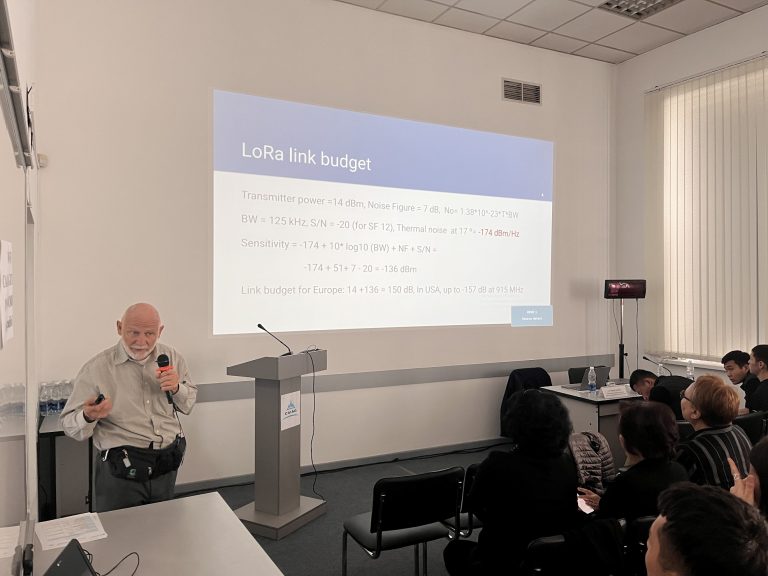
The RIPE 89 Meeting, held in Prague, brought together a vibrant mix of technology enthusiasts and industry experts to share knowledge on data, networking, and innovation. Organized by the RIPE Network Coordination Centre (RIPE NCC), this annual gathering serves as a crucial forum for fostering collaboration and exchanging ideas within the global internet community. One of the standout sessions was “From Mountains to Data,” presented by Aziz Soltobaev under the RIPE Academic Cooperation Initiative (RACI). This talk illustrated the journey of turning raw natural data into valuable digital insights.
In his presentation, Aziz Soltobaev discussed how immense, raw data sourced from the natural world can be transformed into actionable information. This theme transcends theoretical discussion and dives into practical solutions for collecting, managing, and analyzing vast environmental data sets. The metaphor of mountains symbolized both the physical challenge of remote data collection and the inherent complexity of processing unrefined data.

In his presentation at RIPE 89, Aziz Soltobaev emphasized the challenges of data collection in Kyrgyzstan’s mountainous regions, stating, «Deploying sensors in these remote areas is not just about technology; it’s about overcoming logistical hurdles and ensuring data reliability.»

Key Insights and Technological Challenges

Data Collection in Remote Areas: Soltobaev highlighted the difficulties encountered when gathering data in rugged, mountainous regions. Deploying sensors, ensuring reliable data transmission, and dealing with extreme conditions demand both creative problem-solving and technological ingenuity.
Advanced Data Processing: After collection, raw data must be processed to uncover valuable insights. Soltobaev underscored the importance of powerful computational tools like machine learning algorithms and high-performance computing to effectively analyze and interpret this data.
Transforming Data into Decisions: The ultimate aim of this data transformation is to support informed decision-making in areas such as environmental preservation, urban development, and disaster preparedness. Soltobaev provided examples where analyzed data was used to predict natural events and assess their potential impact on communities. «By transforming raw environmental data into actionable insights, we can make informed decisions in urban planning and disaster preparedness, ultimately benefiting our communities», Aziz said.

Relevance for Networking and Technology Experts
This topic holds significant relevance for the RIPE community. Soltobaev’s insights highlighted parallels between challenges in environmental data handling and the complexities of managing global network infrastructures. Both require scalable, resilient systems capable of adapting to varied and sometimes overwhelming data demands.

Future Perspectives
The presentation “From Mountains to Data” underscored a broader message: the convergence of data, technology, and environmental understanding can lead to innovative, cross-disciplinary solutions. By tackling complex data with the right tools and methodologies, what once seemed insurmountable can be turned into actionable knowledge that benefits multiple sectors.

This session at RIPE 89 emphasized that, with determination and the right technological strategies, even the most challenging data can be harnessed to pave the way for smarter, data-driven decision-making across environmental and technical landscapes.

Additional links:

  • https://ripe89.ripe.net/programme/meeting-plan/iot-wg/
  • https://ripe89.ripe.net/programme/blog/
  • https://ripe89.ripe.net/archives/video/1476/

Поход на высокогорное озеро Адыгене

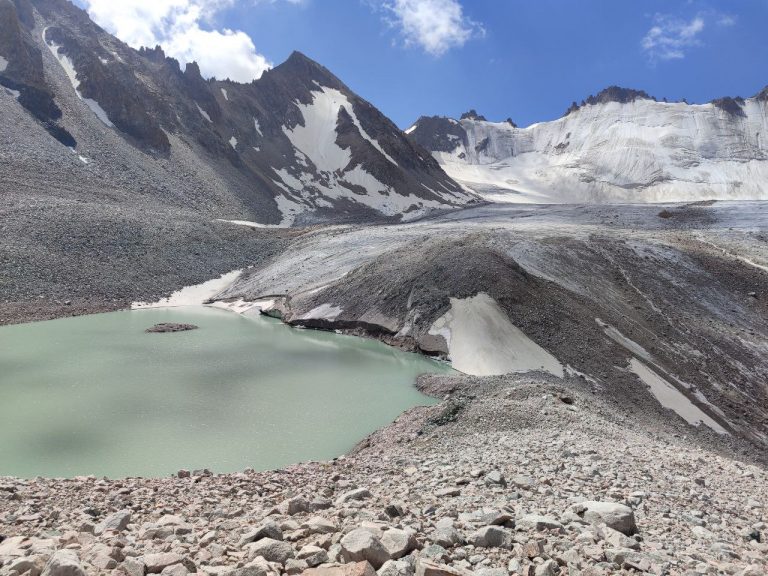
21 июля исследовательская группа ISOC отправилась в экспедицию к ледниковому озеру Адыгене, стратегически расположенному в 60 км к юго-юго-западу от Бишкека. Это высокогорное ледниковое озеро, расположенное на высоте 3600 м в верховьях долины реки Адыгене, левого притока реки Ала-Арча является нашей следующей пилотной локацией для размещения IoT-датчиков, предназначенных для мониторинга паводков, вызванных прорывами ледникового озера.
Адыгене, расположенный на морене ледника, включает в себя еще три озера на юге и юго-востоке. Самое юго-восточное озеро, расположенное на высоте 3640 метров, образовалось вдоль северного края ледника, южным берегом примыкая к самому леднику. Озеро имеет длину 188 метров и ширину 70 метров в самом широком месте, имеет периметр 550 метров и площадь 17 142 квадратных метра. Ручей течет с северо-восточной стороны и после 330-метрового пути сливается с небольшим моренным озером. Кроме того, в южной части озера расположены еще десять небольших моренных озер.

Под руководством нашего партнера – Института водных проблем АН КР – на ледниковом озере Адыгене проводиись мониторинги с использованием различных технологических средств. Станция Адыгене, созданная в 2008 году, играет ключевую роль в изучении высокогорных озер и ледников, одновременно защищая местное население от потенциальных прорывов. Рядом со станцией установлена традиционная метеорологическая станция, где исследователи вручную собирают ежедневные данные с помощью датчиков и получают информацию с автоматической станции.

Первоначально из-за отсутствия покрытия мобильной связи использовалась геостационарная спутниковая связь. Однако из-за бюджетных ограничений от этого варианта отказались, учитывая непомерные для бюджета Института ежемесячные расходы в размере от 200 до 500 долларов США на связь.

Признавая наличие прямой видимости с определенных участков с базовыми станциями Чуйской долины, исследовательская группа Кыргызского отделения ISOC и ICTP предложила внедрить LoRaWAN технологию, которая могла быть обеспечить круглосуточный мониторинг в режиме реального времени, 7 дней в неделю по более доступному ежемесячному тарифу на подключение к GSM за 3 доллара.

Руководствуясь этим стратегическим обоснованием, члены Кыргызского отделения ISOC и стажеры Института водных проблем отправились в утомительный шестичасовой поход к месту происшествия. Путешествие характеризовалось сложным рельефом, переходом от жаркой летней погоды к дождливой и ветреной погоде, сопровождавшейся колебаниями температуры до 20 градусов.

Достигнув пункта назначения, команда тщательно оценила возможности подключения, определила потенциальные места для установки коммуникационного шлюза, определила типы необходимых измерений и датчиков и наметила необходимые установки мачт. После напряженного дня поздно вечером команда вернулась на главную дорогу национального парка Ала-Арча. На основе собранных данных был сформулирован комплексный план работ и логистики для установки инфраструктуры Интернета вещей на ледниковом озере Адыгене.

Обеспечиваем регулярное техобслуживание LoRaWan сети и сенсоров

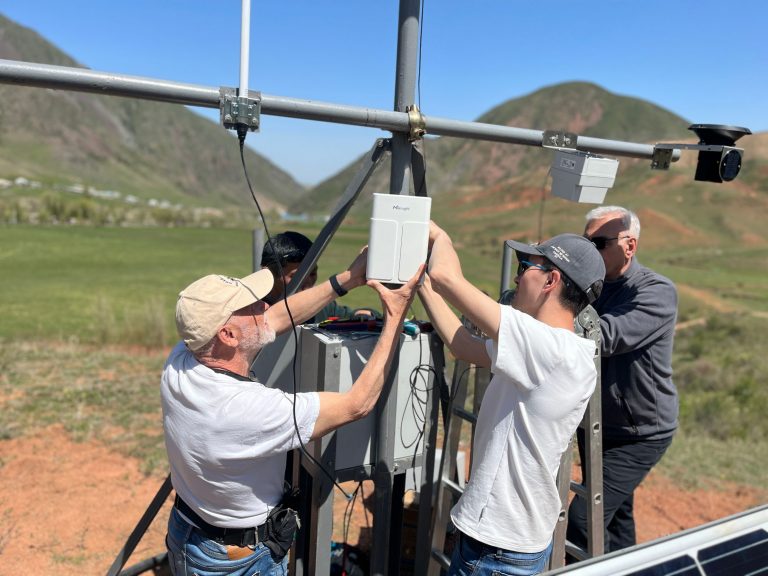
The ISOC Kyrgyz Chapter team has been actively engaging in routine maintenance visits to our pilot locations. Since the initial installation of LoRa-enabled sensors, certain units have necessitated additional on-site attention to ensure optimal performance.

In some instances, ensuring the proper functioning of sensors called for tasks such as excavation from the soil, recalibration, and subsequent reburial. In other cases, the effective operation of sensors demanded the application of specific, albeit previously undocumented, installation techniques. Additionally, challenges arose in certain cases due to inconsistent sensor quality from specific vendors.

To address these complexities, interns from the Institute of Water Problems were actively involved in the process. Their participation served a dual purpose – to offer hands-on training and education and to facilitate the exchange of expertise with students.

As we continue to progress through the data collection stage of our research project, these maintenance efforts remain instrumental in ensuring the accuracy and reliability of our LoRa-enabled sensors in diverse environmental conditions.

Панель данных LoraWan IoT Кыргызстан

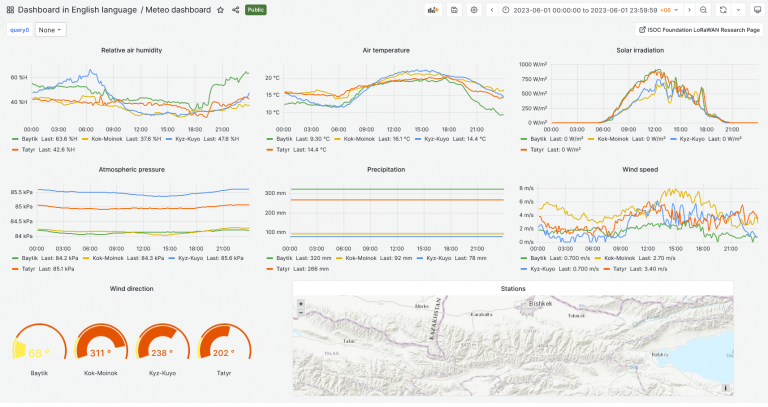
The team created beta version of the dashboard visualization of the project data collected from pilot locations.

The dashboard represents visualization of the following data: relative air humidity, air temperature, solar irradiation, atmospheric pressure, precipitation, wind speed, wind direction. The other dashboard represents visualization of the following data: soil moisture and precipitation, water level. Dashboards are available in Kyrgyz, English and Russian languages. Some dashboards are specially designed for local communities to use for the benefit of community.

We believe in open source solutions. That’s why we use Grafana — a multi-platform open source analytics and interactive visualization web application.The information gathered from Lora-enabled sensors through Lorawan communication gateways and transmitted to the central server via GSM network. Collected IoT telemetry data stored on servers and then visualized using Grafana software. Up-to date information is available via link: http://dashboard.isoc.kg

Note. Since its scientific project, some publicly available data may have wrong parameters or data due to internal experiments, settings, tuning, etc. Please consult before use in research purposes.

Установка Lorawan метеостанций и сенсоров мониторинга природных явлений в Боомском ущелье

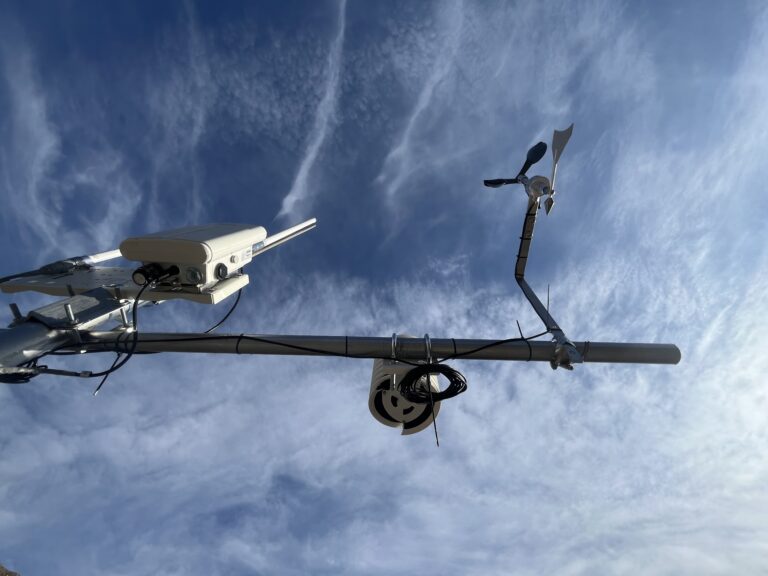
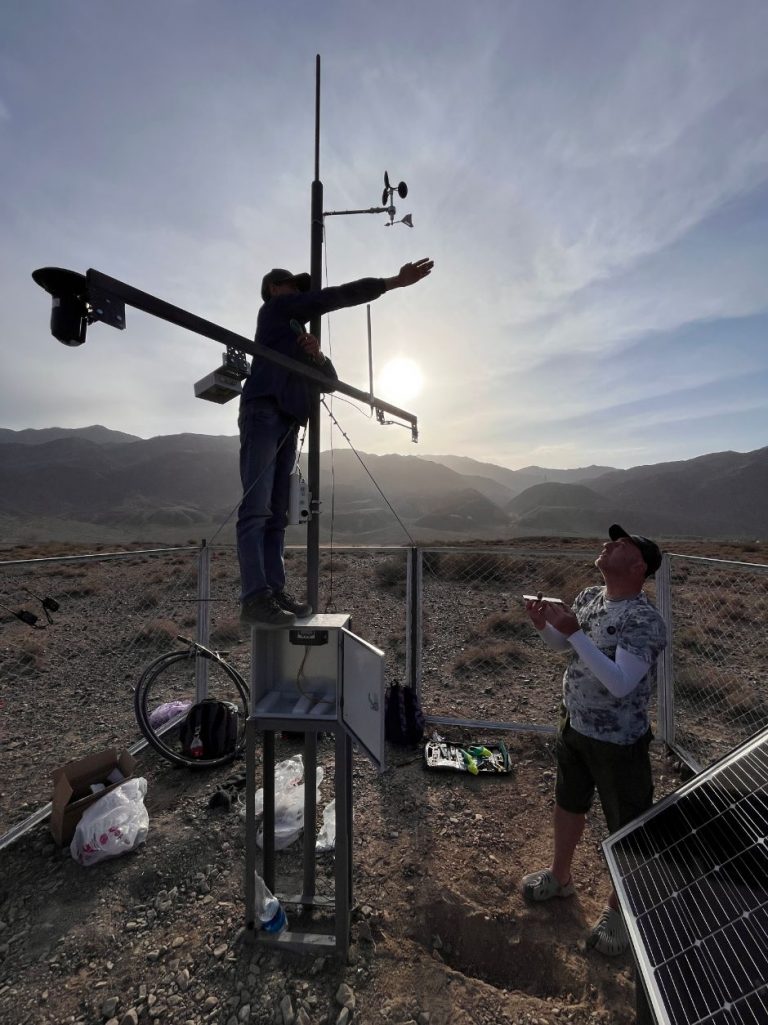
The ISOC Kyrgyz Chapter team, in response to a request from the Ministry of Emergency Situations, has made a crucial advancement in natural disaster mitigation and management. From May 7 to May 17, 2023, the team installed two Lorawan-enabled meteostations and additional sensors in the Boom Gorge of the Kyrgyz Republic. This vital initiative aims to enhance the understanding and monitoring of the region’s distinct microclimate, providing key data to inform preemptive action and disaster management.

The Boom Gorge, marked by unique orographic features and a complex geological structure, has historically grappled with the impacts of heavy rainfalls. These intense precipitations often trigger powerful mudflows, draining from side valleys onto railroads and roads, causing significant infrastructural damage and posing public safety risks. Given the challenges posed by climate change, obtaining accurate and reliable local environmental and meteorological data in this region is becoming increasingly crucial.

In a pioneering research project, the Internet Society Kyrgyzstan Chapter, in collaboration with the Abdus Salam International Centre for Theoretical Physics and the Ministry of Emergency Situations, has been exploring the utility of data transmission using the LoRaWAN protocol in areas susceptible to hazardous natural processes and with limited cellular communications. As part of this research project, two automatic weather stations have been installed in the Boom Gorge, along with additional sensors at key locations: Kyz-Kuye and Kok-Moinok. These locations mark the entry and exit points of the gorge, respectively.

The primary aim of this project at these pilot sites is to monitor and evaluate key meteorological parameters, including precipitation, temperature, moisture, and soil temperature. By doing so, the researchers aim to deepen their understanding of these parameters’ influence on the formation of mudflows in the Boom Gorge.

This installation of automatic weather stations and additional sensors is expected to considerably enhance the accuracy and systematic assessment of meteorological parameters. The use of the LoRaWAN data protocol technology enables continuous monitoring, providing more accurate and up-to-date data while reducing connection operating costs. This invaluable data will underpin informed decisions about mudflow risks and mitigation strategies.

Moreover, the placement of these local weather stations and sensors will facilitate comprehensive studies on the influence of meteorological parameters on mudflow formation processes. In the future, the data collected will enable the Department for Monitoring and Forecasting Natural Disasters of the Ministry of Emergency Situations to determine the threshold values needed to build a high-quality temporal forecast of mudflow events in the Boom Gorge.

Through this blend of technology and scientific research, we aim to deepen our understanding of mudflow dynamics and develop effective measures to mitigate their adverse impacts on infrastructure and people’s lives. The ISOC Kyrgyz Chapter and the Department of Monitoring and Disaster Forecasting are proud to contribute to this vital research project, fostering a safer and more sustainable future for the region.

The Internet Society Foundation’s research grant program funds this pioneering project, with the implementation by the Internet Society Kyrgyz Chapter Public Association and the Abdus Salam International Centre for Theoretical Physics.

Датчики и Lorawan технологии для мониторинга оползня Татыр

On April 27, 2023, a team comprising representatives from the ISOC Kyrgyz Chapter, ICTP, and CAIAG successfully installed and launched Lorawan-enabled sensors on the Tatyr landslide.

The Tatyr landslide is geographically situated 30-40 km south of Bishkek. Administratively, the area is part of the Arashan aiyl district within the Alamedin district. Formed on a north-facing slope, the landslide extends for 1510 meters, with a width varying between 250 to 300 meters, and a thickness ranging from 10 to 15 meters. The landslide involves loamy soils, encompassing the underlying Paleogene-Neogene age rocks. Its formation is primarily attributed to anomalous atmospheric precipitation, coupled with the impact of groundwater emerging as springs and a proximate tectonic fault. The last significant activity was recorded in 2004 when the landslide moved 70 meters following a year of intense rainfalls. The landslide lies along the route to popular skiing locations and tourist destinations. Previously, monitoring was performed manually through periodic on-site visits. The site’s proximity to Bishkek city made it an ideal pilot location for this research project, allowing for swift sensor calibrations and validation of research goals.

Bolot Moldobekov from CAIAG provided an overview of the landslide, discussing its features, historical background, and offering practical guidance on sensor installation for accurate data collection. Ermanno Pietrosemoli from the ICTP trained the team on the installation of Lorawan gateways, antennas, signal calibration, firmware upgrading, and sensor connection via Lorawan frequencies. Marco Zennaro assisted with the installation of monitoring software, providing a practical demonstration of how MQTT works and ensuring the secure transmission of data to servers through VPN channels. All team members participated in the installation of masts, equipment, sensors, and the establishment of a protective perimeter around the site.

The sensor installation aims to practically test and validate Lorawan technology, sensors, and the power of open-source solutions. It is anticipated that the equipment will generate automatic data via Lorawan and transmit it to the servers, benefitting key stakeholders and local communities. Furthermore, the data will be visualized in a user-friendly format, enabling interested parties to understand and assess the current situation efficiently.

Additional information on the Tatyr landslide: The active 70-meter slope movement recorded in May 2004 came just a year after 2002’s high precipitation year, which triggered widespread slumping of the foothill and some mountain slopes. This suggests that the landslide’s base is permeated with groundwater from deep fractured zones, requiring substantial time to circulate. Moreover, the Tatyr landslide belongs to deep-seated landslides, encompassing significant depth of slope deposits in its movement. Landslides of this nature are known for their long periods (30-50 years) of stability.

Форум по IoT для изменения климата и управления стихийными бедствиями

On April 25, 2023, the Internet Society Kyrgyz Chapter successfully hosted forum titled «Application of Innovative Technologies in Monitoring and Forecasting Climate Change and Natural Disasters» at the Central-Asian Institute for Applied Geoscience (CAIAG). Organized thanks to a research grant from the ISOC Foundation, the forum drew an impressive crowd of 70 participants, including representatives from esteemed institutions such as the Kyrgyz State Technical University, Manas University, and the Academy of Sciences.

This forum addressed the vital role of technology, especially the Internet of Things (IoT), in mitigating climate change and managing disasters in landlocked, mountainous countries, with a particular focus on the case of Kyrgyzstan. The event served as a platform for sharing valuable insights and knowledge, reinforcing the importance of advanced technologies in climate change monitoring and disaster management.

Renowned expert Marco Zennaro initiated the substantive sessions, illuminating the various opportunities available at the International Centre for Theoretical Physics (ICTP). Subsequently, his presentation «Introduction to the Internet of Things» shed light on how IoT can dramatically enhance our capabilities to monitor and predict climatic changes and environmental disasters, especially in challenging geographies like Kyrgyzstan.

The dialogue around an open and secure IoT infrastructure was deepened by Ermanno Pietrosemoli’s session on «Introduction to LoRaWAN.» This discourse showcased the potential of LoRaWAN as a long-range, low-power wireless platform for establishing an effective IoT network in regions characterized by difficult terrains and connectivity challenges.

B. Moldobekov’s presentation on «Monitoring and Forecasting of Climate Change and Natural Disasters» deepened the understanding of the role that innovative technologies play in tackling climate change and managing natural disasters. A. Zubovich further highlighted this with his presentation on how innovative technologies can be applied in real-world scenarios to monitor and forecast climate change and natural disasters.

Participants were also engaged in presentations and discussions around the practical implementation of IoT technologies, facilitated by Marco Zennaro’s hands-on lab session on the «Use of MQTT for IoT» and the insightful session on the «Use of TinyML in Disaster Monitoring». Both sessions highlighted the transformative role of these technologies in enhancing disaster monitoring and response systems.

The forum, organized by the Internet Society Kyrgyz Chapter and supported by the ISOC Foundation, is a testament to the growing significance of IoT and other innovative technologies in climate change mitigation and disaster management. By focusing on landlocked mountainous countries like Kyrgyzstan, the event underscored the unique challenges and opportunities in these regions. The insights and experiences shared during this forum will undoubtedly shape further advancements in the field and pave the way for innovative, resilient, and sustainable solutions to our global climate crisis.