Наш проект выиграл Moundatin Future Award 2025

I am pleased to announce that on International Mountain Day, December 11, 2025, we received the award for the most innovative project related to

climate change and glacier conservation. The award ceremony took place at the Mountain Partnership of the United Nations headquarters at the Food and Agriculture Organization of the United Nations (FAO) in Rome.

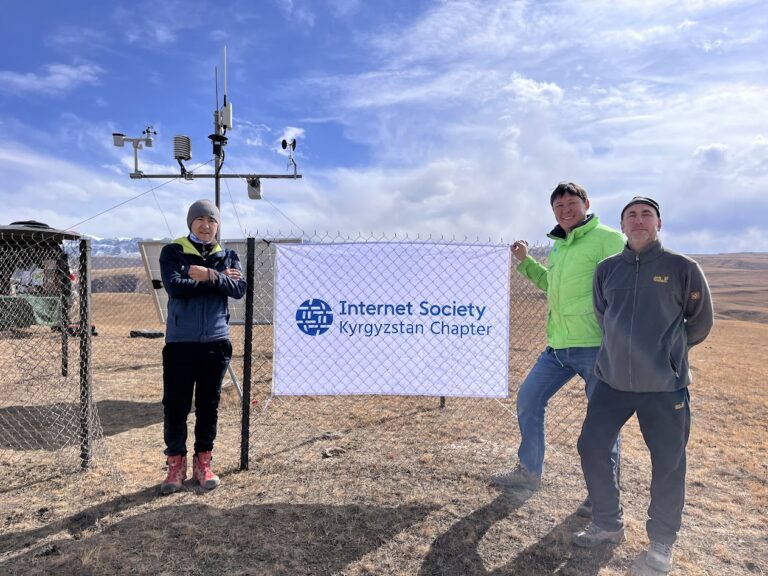
As the project coordinator, I would like to highlight this achievement as a tribute to our outstanding Kyrgyz team: Azhybek Nurlanov, Murat Kaipov, Maksat, Emil, Alexander, and Gulbara Omorova. We are deeply grateful to the Abdus Salam International Centre for Theoretical Physics team — Ermanno Pietrosemoli Marco Rainone Marco Zennaro and Rytis Paskauskas for their technical expertise and constant support in navigating frontier technologies. And profound appreciation to our essential partners who made deployment possible: the Ministry of Emergency Situations of the Kyrgyz Republic, the administration of the Sary-Chelek Nature Reserve and the Karatal-Zhapyryk State Nature Reserve, and scientific institutions across the Central Asian region. We are thankful to the Internet Society Foundation for financial support of our project.

The Internet Society Kyrgyz Chapter’s victory in the Mountain Future Award in the Innovation category validates our work in addressing a critical monitoring gap: in the Pan-Third Pole region, only 10% of weather stations operate above 2,000 meters, and less than 5% above 3,000 meters, despite the fact that these high-altitude zones contain glaciers and permafrost that are most vulnerable to climate change. Kyrgyzstan’s data from only two weather stations located above 2,000 meters was available to the international scientific community. We demonstrate that affordable, advanced meteorological telemetry sensors and technologies like LoRaWAN, Wifi HaLow and EdgeAI can scale monitoring at extreme altitudes, where data is critically needed.

At the end of my speech, I called on countries to recognize climate data as a digital public good to build resilient and sustainable mountain communities. In other words, make such data accessible and free. It still shocks me that in order to write research paper based on the official historical climate data on the cryosphere in Kyrgyzstan, a researcher should spend roughly $3,000-$5,000 for purchasing data from Kyrgyzhydromet, which is already a major barrier to new research. If you would need to know the mean temperature which was this day ten years ago, you need to pay 50 Kyrgyz Soms (57 US cents) for one figure only, while research requires extensive amount of data. Therefore I call all nations to make such data open, free of charge, machine friendly, the digital public good asset.

More information about the event can be found at: https://www.fao.org/webcast/detail/international-mountain-day-2025-high-level-event/en (the Mountain Future Award 2025 ceremony begins at the 57th minute).

#MountainsMatter #InternationalMountainDay #GlacierPreservation

Проснувшись однажды утром после беспокойного сна, Грегор Замза обнаружил, что он у себя в постели превратился в страшное насекомое.

Полевые заметки о вызовах при установке шлюзов в горных районах

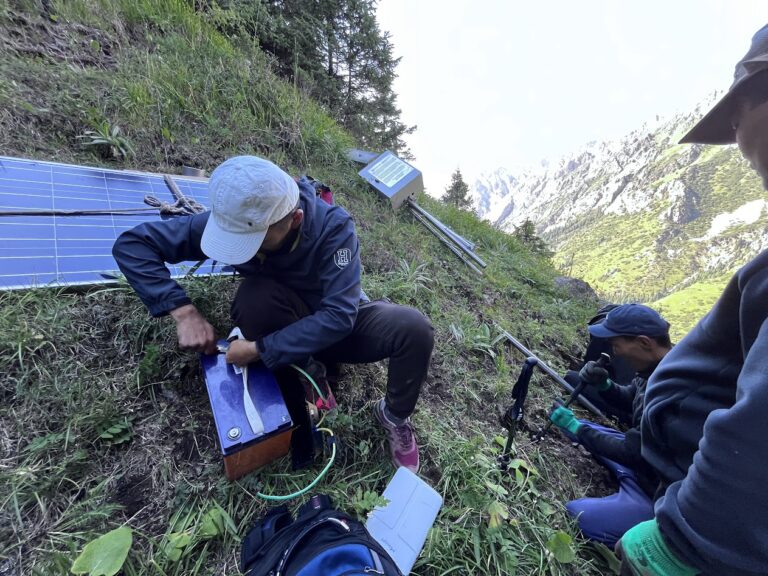
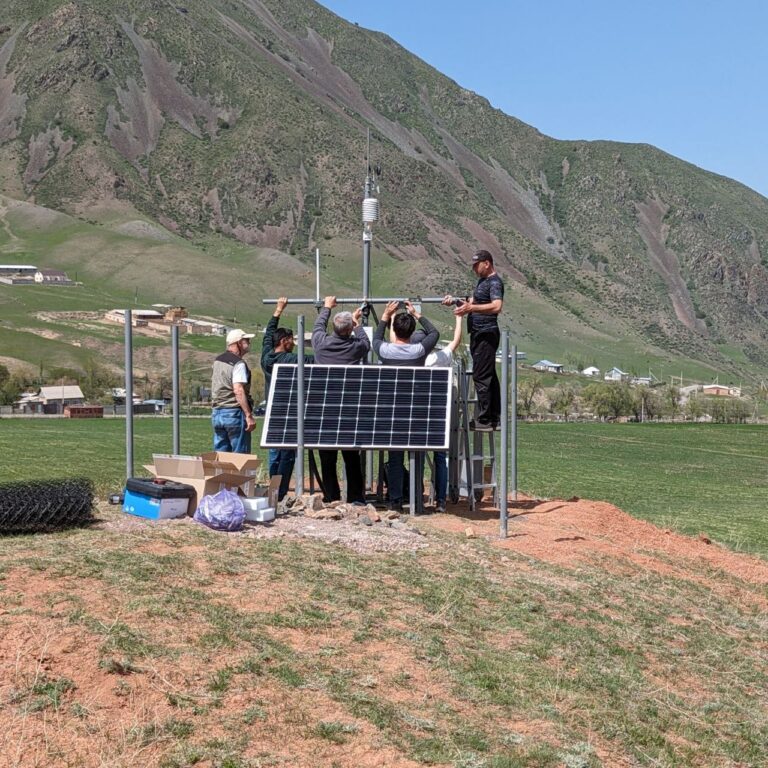
Climbing 700 meters with a 55° slope with solar panels, heavy batteries, and an IoT communication gateway strapped to our backs is not the usual picture of innovation and one wouldn’t think of AI in such context. However, this was exactly what it took to bring climate monitoring communication network to one of the most remote and high altitude places on Earth.
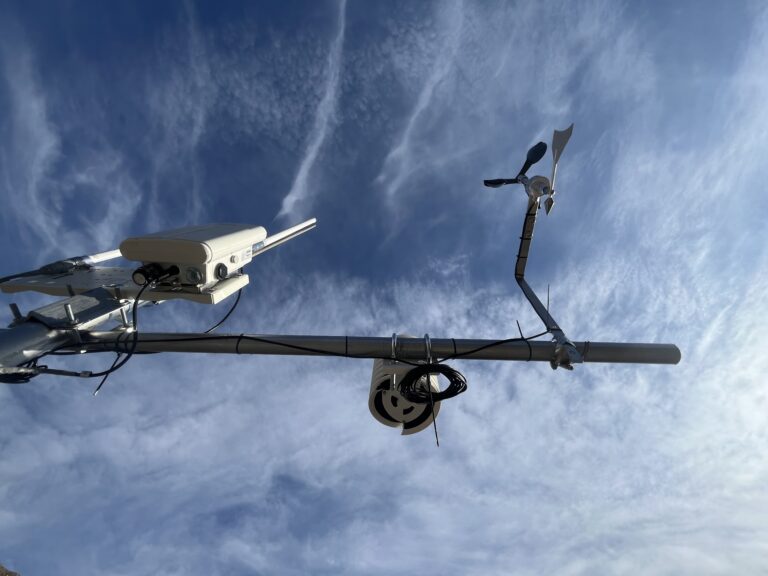
Recently, our team completed the installation of an IoT communication gateway near the Kara-Batkak (3360-4800 altitude) and Aylama glaciers in the Terskey-Alatoo mountain range. This system will connect affordable climate-related sensors at high altitudes — places where critical data is still missing not only in Kyrgyzstan or Third Pole, but globally.

Most foundational climate AI models today rely on assumptions to fill in gaps (cdf-mapping, bias-correction, etc), because the ground data from mountainous regions simply doesn’t exist. The cryosphere — glaciers, snow, and permafrost — remains under-observed, under-researched particularly in the world’s high mountain ranges. The Third Pole Regional Climate Center reported that in the entire Pan-Third Pole region, only 28 monitoring stations sat above 3000 meters out of nearly 700. These are exactly the altitudes where some of the most dramatic changes are taking place.

And the stakes are high. According to ICIMOD even in a world that warms by just 1.5 to 2°C, glaciers in the Third Pole could lose 30 to 50 percent of their volume by the end of this century. Without precise, high-resolution data, real-time data, AI models risk underestimating the hazards we face, from permafrost instability and glacier detachments to glacial lake outburst floods and snow droughts.

That is why Precision matters! Even down to the third-fourth decimal place, every data point helps improve forecasts, anticipate risks, and strengthen climate models that inform policy and adaptation strategies.

The summertime is high season for field works and installations far from the digital sphere in unconnected areas trying to connect the last-mile and secure supply of high precision data for scientists and local communities. For me, the climb was exhausting, but also deeply meaningful. Just like other teammates, I’ve suffered from pain, exhaustion, walking/falling through slippery meadows… Right there in altitude of 3000, looking into the downstream rivers, with spectacular views around, it was a reminder to me that innovation doesn’t only happen in labs, conference rooms, or algorithms. Sometimes it begins with sweat, altitude, and determination — carrying heavy equipment up a mountain so that the world can better understand what is at stake. And it was the second from 15 installations planned under the research project funded by the Internet Society Foundation and implemented by the Internet Society Kyrgyz Chapter along with partners.

Проснувшись однажды утром после беспокойного сна, Грегор Замза обнаружил, что он у себя в постели превратился в страшное насекомое.

От гор к данным – инсайты с выступления на RIPE 89

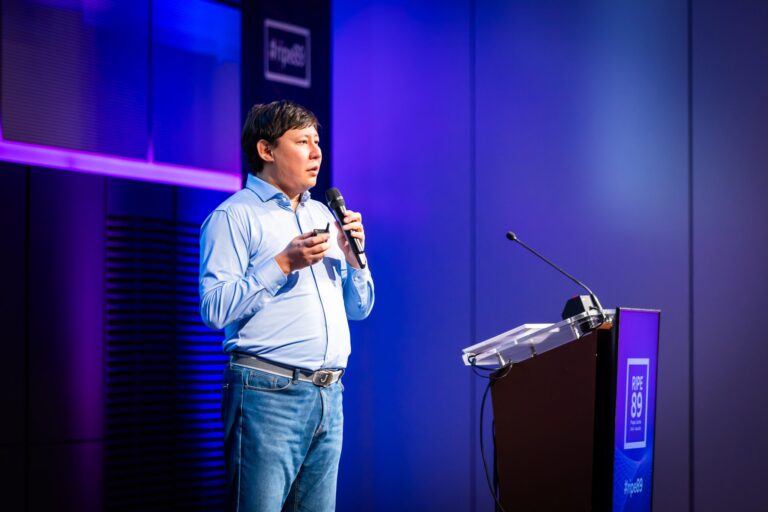
The RIPE 89 Meeting, held in Prague, brought together a vibrant mix of technology enthusiasts and industry experts to share knowledge on data, networking, and innovation. Organized by the RIPE Network Coordination Centre (RIPE NCC), this annual gathering serves as a crucial forum for fostering collaboration and exchanging ideas within the global internet community. One of the standout sessions was “From Mountains to Data,” presented by Aziz Soltobaev under the RIPE Academic Cooperation Initiative (RACI). This talk illustrated the journey of turning raw natural data into valuable digital insights.
In his presentation, Aziz Soltobaev discussed how immense, raw data sourced from the natural world can be transformed into actionable information. This theme transcends theoretical discussion and dives into practical solutions for collecting, managing, and analyzing vast environmental data sets. The metaphor of mountains symbolized both the physical challenge of remote data collection and the inherent complexity of processing unrefined data.

In his presentation at RIPE 89, Aziz Soltobaev emphasized the challenges of data collection in Kyrgyzstan’s mountainous regions, stating, «Deploying sensors in these remote areas is not just about technology; it’s about overcoming logistical hurdles and ensuring data reliability.»

Key Insights and Technological Challenges

Data Collection in Remote Areas: Soltobaev highlighted the difficulties encountered when gathering data in rugged, mountainous regions. Deploying sensors, ensuring reliable data transmission, and dealing with extreme conditions demand both creative problem-solving and technological ingenuity.
Advanced Data Processing: After collection, raw data must be processed to uncover valuable insights. Soltobaev underscored the importance of powerful computational tools like machine learning algorithms and high-performance computing to effectively analyze and interpret this data.
Transforming Data into Decisions: The ultimate aim of this data transformation is to support informed decision-making in areas such as environmental preservation, urban development, and disaster preparedness. Soltobaev provided examples where analyzed data was used to predict natural events and assess their potential impact on communities. «By transforming raw environmental data into actionable insights, we can make informed decisions in urban planning and disaster preparedness, ultimately benefiting our communities», Aziz said.

Relevance for Networking and Technology Experts
This topic holds significant relevance for the RIPE community. Soltobaev’s insights highlighted parallels between challenges in environmental data handling and the complexities of managing global network infrastructures. Both require scalable, resilient systems capable of adapting to varied and sometimes overwhelming data demands.

Future Perspectives
The presentation “From Mountains to Data” underscored a broader message: the convergence of data, technology, and environmental understanding can lead to innovative, cross-disciplinary solutions. By tackling complex data with the right tools and methodologies, what once seemed insurmountable can be turned into actionable knowledge that benefits multiple sectors.

This session at RIPE 89 emphasized that, with determination and the right technological strategies, even the most challenging data can be harnessed to pave the way for smarter, data-driven decision-making across environmental and technical landscapes.

Additional links:

  • https://ripe89.ripe.net/programme/meeting-plan/iot-wg/
  • https://ripe89.ripe.net/programme/blog/
  • https://ripe89.ripe.net/archives/video/1476/

From Mountains to Data Low-Cost Weather Stations in Kyrgyzstan’s Challenging Terrain

On behalf of the research team, I am very pleased to announce that our preprint of a research paper on the use of low-cost automatic weather stations, LoRaWAN technology and various IoT sensors has been published. “From Mountains to Data: Low-Cost Weather Stations in Challenging Conditions in Kyrgyzstan” describes the selection criteria for the equipment to be deployed and provides detailed information on the installation process at the pilot sites, as well as the challenges encountered during the project.

For me, one of the main conclusions of this research project is that there has been a significant breakthrough in the quality and availability of telemetry sensors over the past five years.

Our data analysis shows that two-tier automatic weather stations demonstrate similar results (daily, decadal, monthly averages) with a high degree of accuracy (95-98%) as the first-tier AWS. The only difference is that new technologies have reduced the cost of weather stations by 10-20 times. Instead of $50,000 worth of equipment, you can use $1,000-$5,000 weather stations and get identical results (subject to regular calibration and maintenance of the equipment).

The second important takeaway is the demonstration of the potential of LoRaWAN data transmission technology for rapid deployment and monitoring of climate change, creation of geoinformation models, forecasting future trends, and taking mitigating preventive measures.

The third important takeaway is the practical application of such an approach to data transmission as Delay-Tolerant Networks. With this approach, under adverse external conditions, data can be collected and transmitted later. In the conditions of the pilot project in Kyrgyzstan, DTN showed good performance in severe frost conditions in December 2023, when the temperature dropped to -23-28 degrees. As a result, some nearby cell towers were disconnected for a while, as were some of our sensors. However, data recording continued, and when the network was restored, the data was successfully transmitted to the central server.

The full version of this article will be published in the next issue of the scientific journal Sensors. This scientific work became possible during the implementation of the research project of the Internet Society Kyrgyz Chapter with the financial support of the Internet Society Foundation.