From Mountains to Data Low-Cost Weather Stations in Kyrgyzstan’s Challenging Terrain

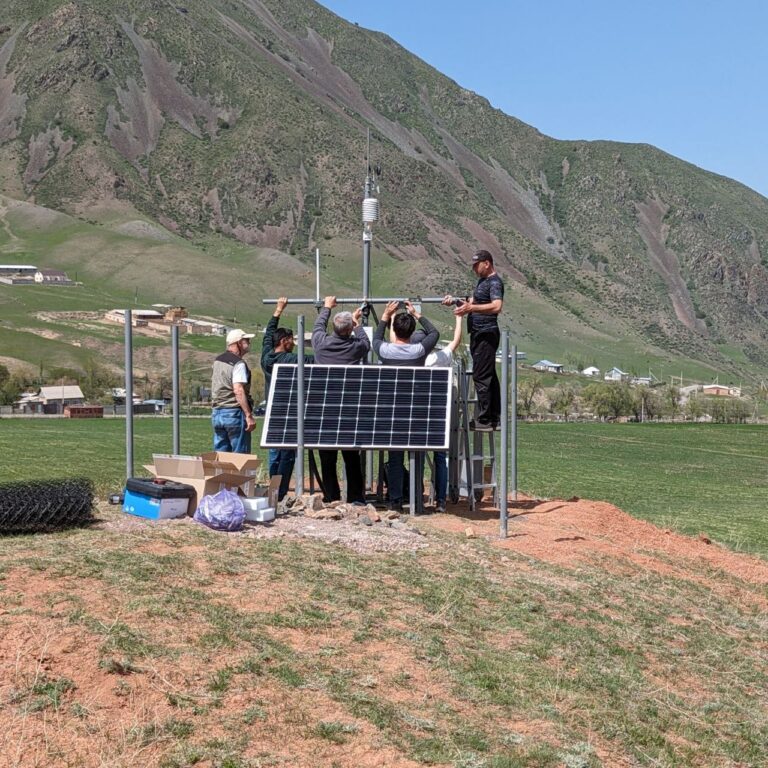
On behalf of the research team, I am very pleased to announce that our preprint of a research paper on the use of low-cost automatic weather stations, LoRaWAN technology and various IoT sensors has been published. “From Mountains to Data: Low-Cost Weather Stations in Challenging Conditions in Kyrgyzstan” describes the selection criteria for the equipment to be deployed and provides detailed information on the installation process at the pilot sites, as well as the challenges encountered during the project.

For me, one of the main conclusions of this research project is that there has been a significant breakthrough in the quality and availability of telemetry sensors over the past five years.

Our data analysis shows that two-tier automatic weather stations demonstrate similar results (daily, decadal, monthly averages) with a high degree of accuracy (95-98%) as the first-tier AWS. The only difference is that new technologies have reduced the cost of weather stations by 10-20 times. Instead of $50,000 worth of equipment, you can use $1,000-$5,000 weather stations and get identical results (subject to regular calibration and maintenance of the equipment).

The second important takeaway is the demonstration of the potential of LoRaWAN data transmission technology for rapid deployment and monitoring of climate change, creation of geoinformation models, forecasting future trends, and taking mitigating preventive measures.

The third important takeaway is the practical application of such an approach to data transmission as Delay-Tolerant Networks. With this approach, under adverse external conditions, data can be collected and transmitted later. In the conditions of the pilot project in Kyrgyzstan, DTN showed good performance in severe frost conditions in December 2023, when the temperature dropped to -23-28 degrees. As a result, some nearby cell towers were disconnected for a while, as were some of our sensors. However, data recording continued, and when the network was restored, the data was successfully transmitted to the central server.

The full version of this article will be published in the next issue of the scientific journal Sensors. This scientific work became possible during the implementation of the research project of the Internet Society Kyrgyz Chapter with the financial support of the Internet Society Foundation.

Кыргызстандагы Lora картасы

In a pioneering initiative, the Internet Society Kyrgyz Chapter has embarked on a groundbreaking project to test and map LoRa-enabled gateway coverage in select pilot locations. This endeavor marks a significant leap forward in the realm of Internet of Things (IoT) technology, aiming to enhance connectivity, streamline data collection, and fortify research efforts.

Mapping LoRa-enabled gateway coverage is a crucial step in advancing IoT infrastructure of the country. LoRa (Long Range) technology, known for its extended range and low power consumption, is increasingly employed in diverse applications, including environmental monitoring, agriculture, and smart city solutions. The success of these applications relies heavily on the optimal placement and coverage of LoRa gateways.

The process of mapping LoRa-enabled gateway coverage involves a meticulous survey of the targeted area, considering topography, geographical features, and potential interference. The ISOC Kyrgyz Chapter, in collaboration with local partners, is employing cutting-edge techniques to identify strategic locations for LoRa gateways. These gateways serve as crucial communication hubs, facilitating the seamless transfer of data between IoT devices and the central network.

The benefits of mapping LoRa-enabled gateway coverage are manifold. Firstly, it ensures that IoT devices within the coverage area can efficiently communicate with the network, enabling real-time data transmission. This is particularly vital for research initiatives focused on environmental monitoring, where timely and accurate data is imperative for informed decision-making.

Secondly, the strategic placement of LoRa gateways optimizes network efficiency, reducing the chances of signal interference and packet loss. This, in turn, enhances the reliability and stability of IoT applications, making them more robust in challenging environments.

From a research perspective, the mapped data provides valuable insights into the performance and limitations of LoRa technology in specific geographic contexts. Researchers can analyze coverage patterns, identify potential dead zones, and fine-tune gateway placements for maximum efficacy. This iterative process of testing and mapping contributes to the continuous improvement of IoT infrastructure, fostering innovation and advancements in diverse fields.

In conclusion, the ISOC Kyrgyz Chapter’s initiative to test and map LoRa-enabled gateway coverage in pilot locations is a commendable stride towards harnessing the full potential of IoT technology. By strategically placing gateways and optimizing coverage, this effort not only enhances connectivity and data reliability but also lays the groundwork for transformative research endeavors that leverage the power of the Internet of Things for natural disaster monitoring and prediction.