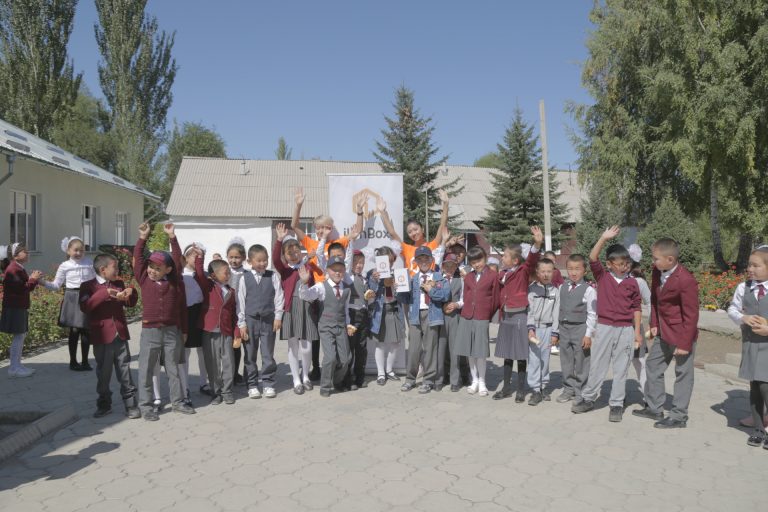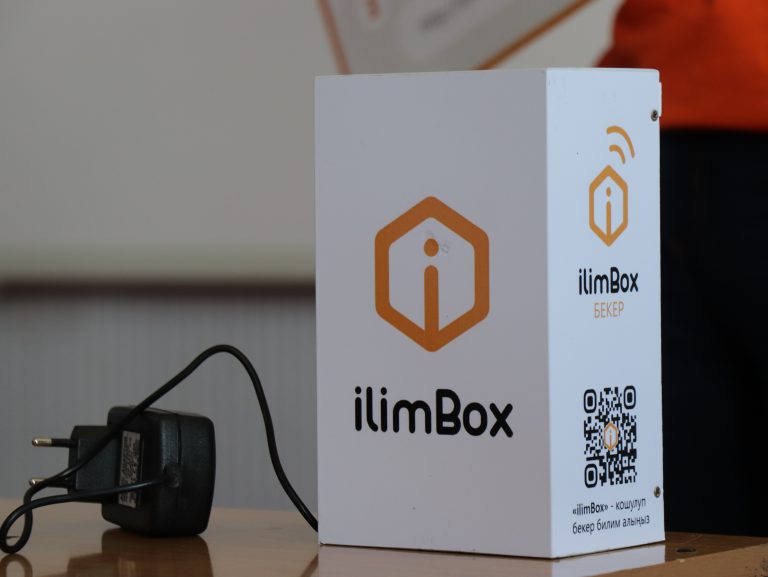
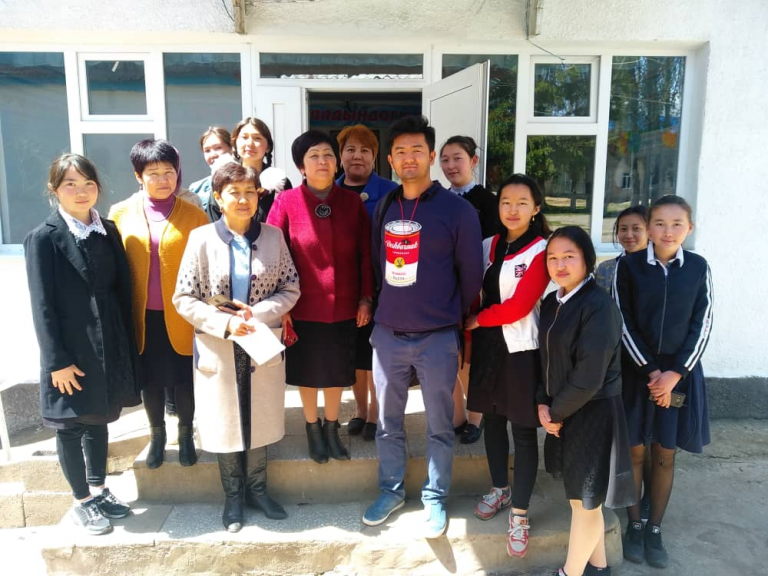
The First school we visited was school №10. Manas (Balykchy) in which 895 children are trained. The school is connected to the Internet, however, it is only the Director’s office, in connection with which this educational institution was included into the list of schools to install electronic library ilimBox.

The Administration warmly welcomed our team and gathered all the high school students in the auditorium. The number of children numbered more than 120 people.
During the presentation it became obvious that it becomes difficult to keep the attention of children of grades 5-6, in connection with which we decided to leave active children and show them the principle of operation of the device in order for them to share their knowledge with their peers,” – said the representative of the ISOC team Begaim bekbolotova.
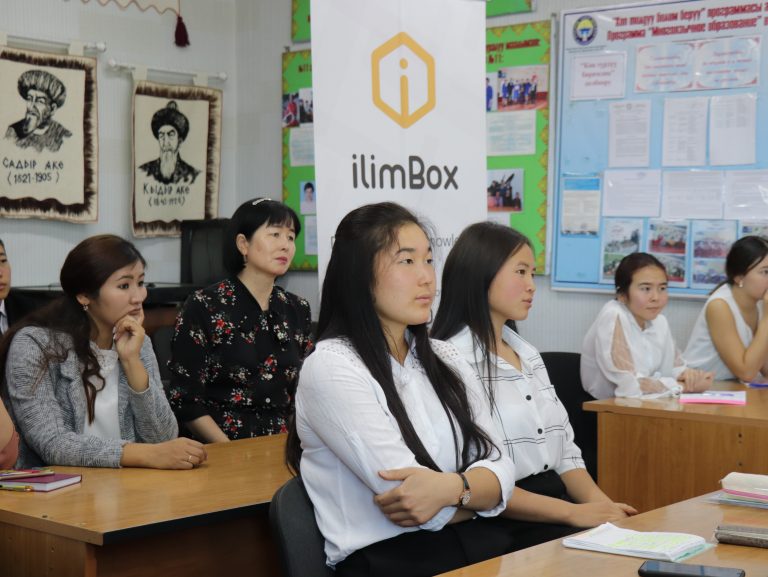
Re-presentation of the project was done in another room for high school students interested in teaching their peers. They actively asked questions and practiced through their smartphones.
The Director of the school – Venera Jusuenvasad: “This project will help our school to solve the issue with the textbooks”. Interest to our project was shown not only by teachers and students, but also by parents who came for children of younger classes, who with great curiosity asked about the possibility of purchasing a device home.
Schoolgirl of senior classes is trying to open electronic library of ilimBoxPresentation of device ilimBoxIn the presentation of ilimBox assembled senior schoolchildren
On September 10-11, 2019, the ISOC team installed the electronic library “Ilim Box” in secondary schools in the southern part of Issyk-Kul region. The device allows you to access all educational resources without an Internet connection, in other words offline. Moreover, it is worth noting that all data is stored in the device itself, and only the power supply and the box itself are needed for connection. The uniqueness of the innovative project is that students can access educational resources at school without an Internet connection. Preparation for the trip took more than two weeks, because in addition to the presentation, the team has developed a new logo that reflects the essence of the project “Ilim Box”. Identification marks were made for the trip: branding boxes, roll-ups, spiders, t-shirts, stickers. The choice of schools was due to several factors: no access to the Internet for students, lack of books, as well as the number of students exceeded the permissible maximum, thereby increasing the likelihood of poor performance in schools without a network connection, as well as the choice of educational institutions influenced the list of proposed schools by the Ministry of education and science of the Kyrgyz Republic. The devices were donated: School № 10 Manas (Balykchy) School №7 (Balykchy) School B. Alakhov (Kara-Taala) School R. Jangaziev (Kara-Koo) School Erkinbaeva (Bar-Bulak) School-gymnasium №11 (Karakol) School Esimbekova (Tegizchil) School D. Turebekov (Boz-Bulun) In these schools was held a presentation of the project “Ilim box” then testing the device with students and teachers and handing the device. During the conversation, the importance of education and self-education were touched upon. Our visit to these schools has caused positive responses from the school administration, as none of them have access to the Internet for students, and most of them stressed the problem of not completing books in both Russian and Kyrgyz languages. It should be noted that in most of the rural schools it is forbidden to use a mobile phone on the territory of the educational institution, as teachers notice children’s gaming preferences during lessons. We showed the guys that with the advent of “Ilim box” smartphone can be used exclusively for educational purposes, and all this can be fun through video lessons. In Kyrgyzstan, there are more than 2,000 schools, among which there are those that do not have access to the Internet and do not have enough books. Accordingly, it affects the level of quality of education. In 2018, Kyrgyzstan declined to participate in the PISA world school rankings, as it was ranked last 65th in previous competitions. Innovative solutions to two pressing problems such as the lack of books and the lack of Internet can be seen in the project digital library for schools and public libraries “Ilim Box”, which contains Wikipedia in Kyrgyz, Russian and English, Khan Academy in English, thousands of video lessons, audio and e-books. All these digital learning materials are available offline, in other words does not need Internet access. Access to Digital libraries will be carried out through smartphones, tablets, computers and any other personal devices with Wi-Fi technology. “Ilim Box” will allow Kyrgyzstan to increase the level of education in the regions”, – said the Chairman of ISOC – Talant Sultanov, at the digital forum of Kazakhstan. Thus, visits to schools helped to identify several important points: need to develop a training manual on Kyrgyz language for better perception of information is needed in the formation of a database of electronic books, the materials should be in Russian and Kyrgyz languages, there is a need to create a list of the most useful books, and download online tests for the preparation to ORT. The goals and objectives of the project “Ilim Box” coincide with the five-year strategy of digital transformation “Digital Kyrgyzstan 2019-2023” and contribute to the achievement of target indicators for the component “development of the digital state” and “development of digital skills”. The project is funded by Alumni Engagement Innovation Fund 2018 (AEIF) as part of innovative solutions to global challenges and by program Beyond the Net ISOC.
The project previously had various names “Internet in a box”, “Bilim Bulagy”, “Spring of Knowledge”and is not related to the World Bank project “Bilim Bulagy”.
On April 13, 2019, the ISOC team began installing the Bilim Bulagy electronic library. The device allows you to access all educational resources without an Internet connection, in other words offline. Moreover, it should be noted that all data is stored in the device itself, and only power supply and wireless modem are required for connection. The uniqueness of the innovative project is that students can access educational resources at school without an Internet connection.
The first schools where the trip was organized were the secondary school O. Isaeva (Kegety) and Chui boarding school (Tokmok) located in the Chui valley. The choice of schools was due to several factors: there is no access to the Internet, the number of students exceeded the allowable maximum, thereby increasing the likelihood of poor performance in schools without a network connection, as well as the choice of the above-described educational institutions was influenced by the interest Of the Association of young entrepreneurs “JIA” and the club of professionals “ProKG”, as they have a project “My school” with supervised schools.
For example, in high school O. Isaeva (Kegety) 511 students study, and the number of computers is equal to thirty-three, there is only one computer connected to the Internet. The second school is Chui boarding school (Tokmok), which has approximately the same performance. In these schools was held a presentation of the project “Internet in a box” then testing the device with students and teachers. During the conversation, the importance of education and self-education were touched upon.
The third school was in S. Boroldai of Kemin district of Chui region. The plan of the meeting was built in the same way. Since the school is Russian-speaking, the appeal of teachers was aimed at increasing the materials in Russian, which would greatly facilitate the process of knowledge transfer.
There are more than 2,000 schools in Kyrgyzstan, some of which do not have access to the Internet and lack books. Accordingly, it affects the level of quality of education. In 2018, Kyrgyzstan declined to participate in the PISA world school rankings, as it was ranked last 65th in previous competitions.
Innovative solutions to two pressing problems such as the lack of books and the lack of the Internet can be seen in the project “Bilim Bulagy” (Internet in a box) – a digital library for schools and public libraries containing Wikipedia in Kyrgyz, Russian and English languages, Khan Academy, thousands of video lessons, audio and e-books. All these digital learning materials are available offline, in other words does not need Internet access. Access to Digital libraries will be carried out through smartphones, tablets, computers and any other personal devices with Wi-Fi technology.
“Bilim Bulagy will allow Kyrgyzstan to improve the level of education in the regions”, – said the Chairman of ISOC – Talent Sultanov, at the digital forum of Kazakhstan.
Thus, visits to schools helped to identify several important points: it is necessary to develop a manual in the Kyrgyz language for better perception of information, there is a need in the formation of the database of electronic books, materials should be both in Russian and in Kyrgyz, there is a need to create a list of the most necessary books. The goals and objectives of the project “Bilim Bulagy” coincide with the five-year strategy of digital transformation “Digital Kyrgyzstan 2019-2023” and contribute to the achievement of target indicators for the component “development of the digital state” and “development of digital skills”.
The project is funded by Alumni Engagement Innovation Fund 2018 (AEIF) as part of innovative solutions to global challenges.
Thanks to grants from the American Embassy in Kyrgyzstan and the Internet Society, the Public Association “Kyrgyz Branch of the Internet Society” starts the project “Bilim Bulagy”. Bilim Bulagy is a digital library for schools and public libraries containing Wikipedia in Kyrgyz, Russian and English, the Khan Academy, thousands of video lessons, audio and electronic books. All these digital learning materials are available offline, that is, without needing access to the Internet. Access to the Digital Libraries will be provided through smartphones, tablets, computers and any other personal devices with Wi-Fi technology.

Many schools in Kyrgyzstan annually experience a shortage of teachers and textbooks. As a result, thousands of children do not receive a proper quality education. In particular, there are not enough teachers of the exact sciences and the Russian language. As a result, Kyrgyz schoolchildren show poor knowledge of such fundamental skills like reading and computing. This is evidenced by the results of the PISA International Student Assessment, where students from Kyrgyzstan showed the worst results and finished last in 2006 and 2009.
Bilim Bulagy aims to provide opportunities for students to fill in missing knowledge on their own. Similarly, the lessons of the Khan Academy have the potential to help retarded students understand complex topics.
Over 6 million Wikipedia articles will be available for reading in three languages helping to develop curiosity in children.
Many digital learning materials are also available for download, thus allowing you to take a piece of the library with you. Download speed is very high, because it does not use the Internet, but only its internal network.
Bilim Bulagy will be implemented in 50 pilot schools and libraries in the country in 2019.